
Hyundai Accent (HC): Infotainment System / Braking system
Contents:
- Power Brakes
- Disc Brakes Wear Indicator
- Parking Brake
- Anti-lock Brake System (ABS)
- Electronic Stability Control (ESC)
- Vehicle Stability Management (VSM)
- Hill-Start Assist Control (HAC)
- Good Braking Practices
Power Brakes
Your Hyundai Accent has power-assisted brakes that adjust automatically through normal usage.
If the engine is not running or is turned off while driving, the power assist for the brakes will not work. You can still stop your vehicle by applying greater force to the brake pedal than typical. The stopping distance, however, will be longer than with power brakes.
When the engine is not running, the reserve brake power is partially depleted each time the brake pedal is applied. Do not pump the brake pedal when the power assist has been interrupted.
Pump the brake pedal only when necessary to maintain steering control on slippery surfaces.
WARNING
Take the following precautions:
- Do not drive with your foot resting on the brake pedal. This will create abnormal high brake temperatures, excessive brake lining and pad wear, and increased stopping distances.
- When descending down a long or steep hill, move the gear shift lever to Manual Shift Mode and manually downshift to a lower gear in order to control your speed without using the brake pedal excessively. Applying the brakes continuously will cause the brakes to overheat and could result in a temporary loss of braking performance.
- Wet brakes may impair the vehicle's ability to safely slow down; the vehicle may also pull to one side when the brakes are applied. Applying the brakes lightly will indicate whether they have been affected in this way. Always test your brakes in this fashion after driving through deep water. To dry the brakes, lightly tap the brake pedal to heat up the brakes while maintaining a safe forward speed until brake performance returns to normal. Avoid driving at high speeds until the brakes function correctly.
Additional reminder: After driving through water or heavy rain, allow extra stopping distance in your Hyundai Accent until you confirm the brakes feel normal again.
Disc Brakes Wear Indicator
When your brake pads are worn and new pads are required, you will hear a high pitched warning sound from your front or rear brakes. You may hear this sound come and go or it may occur whenever you depress the brake pedal.
Note that some driving conditions or climates may cause a brake squeal when you first apply (or lightly apply) the brakes. This is normal and does not indicate a problem with your brakes.
NOTICE
To avoid costly brake repairs, do not continue to drive with worn brake pads.
Information
Always replace brake pads as complete front or rear axle sets.
Parking Brake
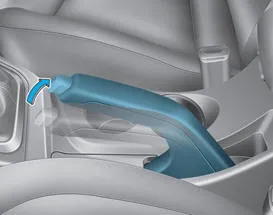
Always set the parking brake before leaving the vehicle. To apply the parking brake:
Firmly depress the brake pedal.
Pull up the parking brake lever as far as possible.
WARNING
To reduce the risk of SERIOUS INJURY or DEATH, do not operate the parking brake while the vehicle is moving except in an emergency situation. It could damage the brake system and lead to an accident.
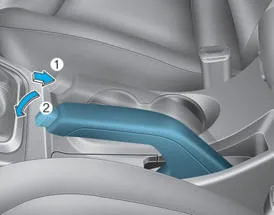
To release:
Firmly depress the brake pedal.
While pressing the release button (1), slightly pull up on the parking brake lever then lower the parking brake lever (2).
If the parking brake does not release or does not release all the way, have your vehicle checked by an authorized HYUNDAI dealer.
WARNING
- Whenever leaving the vehicle or parking, always come to a complete stop and continue to depress the brake pedal. Move the shift lever into P (Park) position, then apply the parking brake, and place the ignition switch in the LOCK/OFF position. Vehicles with the parking brake not fully engaged are at risk for moving inadvertently and causing injury to yourself or others.
- When parking on an incline, block the wheels to prevent the vehicle from rolling down.
- NEVER allow anyone who is unfamiliar with the vehicle to touch the parking brake. If the parking brake is released unintentionally, serious injury may occur.
- Only release the parking brake when you are seated inside the vehicle with your foot firmly on the brake pedal.
NOTICE
- Do not apply the accelerator pedal while the parking brake is engaged. If you depress the accelerator pedal with the parking brake engaged, warning will sound. Damage to the parking brake may occur.
- Driving with the parking brake on can overheat the braking system and cause premature wear or damage to brake parts. Make sure the parking brake is released and the Brake Warning Light is off before driving the Hyundai Accent.

Check the Parking Brake Warning Light by placing the ignition switch to the ON position (do not start the engine).
This light will be illuminated when the parking brake is applied with the ignition switch in the START or ON position. Before driving, be sure the parking brake is released and the Brake Warning Light is OFF.
If the Parking Brake Warning Light remains on after the parking brake is released while engine is running, there may be a malfunction in the brake system. Immediate attention is necessary.
If at all possible, cease driving the vehicle immediately. If that is not possible, use extreme caution while operating the vehicle and only continue to drive the vehicle until you can reach a safe location.
Anti-lock Brake System (ABS)
WARNING
An Anti-Lock Braking System (ABS) or an Electronic Stability Control (ESC) system will not prevent accidents due to improper or dangerous driving maneuvers. Even though vehicle control is improved during emergency braking, always maintain a safe distance between you and objects ahead of you. Vehicle speeds should always be reduced during extreme road conditions. The braking distance for cars equipped with ABS or ESC may be longer than for those without these systems in the following road conditions.
Drive your vehicle at reduced speeds during the following conditions:
- Rough, gravel or snow-covered roads.
- On roads where the road surface is pitted or has different surface height.
- Tire chains are installed on your vehicle.
The safety features of an ABS or ESC equipped vehicle should not be tested by high speed driving or cornering. This could endanger the safety of yourself or others.
ABS is an electronic braking system that helps prevent a braking skid by reducing wheel lock-up. In the Hyundai Accent, ABS helps you maintain steering control while braking, so you can steer and brake at the same time when road traction is limited.
WARNING
If the ABS warning light ( ) is on and stays on, you may have a problem with the ABS. Your power brakes will work normally. To reduce the risk of serious injury or death, contact your HYUNDAI dealer as soon as possible.
CAUTION
When you drive on a road having poor traction, such as an icy road, and apply your brakes continuously, the ABS will be active continuously and the ABS warning light (
 ) may illuminate. Pull your car over to a safe place and turn the engine off.
Restart the engine. If the ABS warning light is off, then your ABS system is normal.
Otherwise, you may have a problem with your ABS system. Contact an authorized HYUNDAI dealer as soon as possible.
Information
When you jump start your vehicle because of a drained battery, the ABS warning light (
 ) may turn on at the same time. This happens because of the low battery voltage. It does not mean your ABS is malfunctioning. Have the battery recharged before driving the vehicle.
Small addition: When ABS activates in your Hyundai Accent, you may feel a pulsation in the brake pedal or hear a buzzing sound. Keep firm, steady pressure on the brake pedal and steer smoothly—this is normal ABS operation.
Electronic Stability Control (ESC)
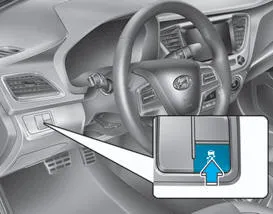
The Electronic Stability Control (ESC) system helps to stabilize the vehicle during cornering maneuvers. ESC checks where you are steering and where the vehicle is actually going. ESC applies braking pressure to any one of the vehicle's brakes and intervenes in the engine management system to assist the driver with keeping the Hyundai Accent on the intended path. It is not a substitute for safe driving practices. Always adjust your speed and driving to the road conditions.
WARNING
Never drive too fast for the road conditions or too quickly when cornering. The ESC system will not prevent accidents.
Excessive speed in turns, abrupt maneuvers, and hydroplaning on wet surfaces can result in severe accidents.
ESC operation
ESC ON condition
When the ignition switch is in the ON position, the ESC and the ESC OFF indicator lights illuminate for approximately three seconds. After both lights go off, the ESC is enabled.
When operating

When the ESC is in operation, the ESC indicator light blinks:
- When you apply your brakes under conditions which may lock the wheels, you may hear sounds from the brakes, or feel a corresponding sensation in the brake pedal. This is normal and it means your ESC is active.
- When the ESC activates, the engine may not respond to the accelerator as it does under routine conditions.
- If the Cruise Control was in use when the ESC activates, the Cruise Control automatically disengages. The Cruise Control can be reengaged when the road conditions allow. See "Cruise Control System" later in this chapter. (if equipped)
- When moving out of the mud or driving on a slippery road, the engine RPM (revolutions per minute) may not increase even if you press the accelerator pedal deeply. This is to maintain the stability and traction of the vehicle and does not indicate a problem.
ESC OFF condition
To cancel ESC operation :
• State 1
Press the ESC OFF button briefly. The ESC OFF indicator light and message "Traction Control disabled“ will illuminate. In this state, the traction control function of ESC (engine management) is disabled, but the brake control function of ESC (braking management) still operates.
• State 2
Press and hold the ESC OFF button continuously for more than 3 seconds. The ESC OFF indicator light and message "Traction & Stability Control disabled" illuminates and a warning chime sounds. In this state, both the traction control function of ESC (engine management) and the brake control function of ESC (braking management) are disabled.
If the ignition switch is placed to the LOCK/OFF position when ESC is off, ESC remains off. Upon restarting the engine, the ESC will automatically turn on again.
Indicator lights
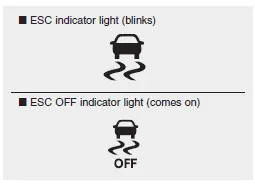
When the ignition switch is placed to the ON position, the ESC indicator light illuminates, then goes off if the ESC system is operating normally.
The ESC indicator light blinks whenever the ESC is operating.
If ESC indicator light stays on, your vehicle may have a malfunction with the ESC system. When this warning light illuminates have your vehicle checked by an authorized HYUNDAI dealer as soon as possible.
The ESC OFF indicator light comes on when the ESC is turned off.
WARNING
When the ESC is blinking, this indicates the ESC is active:
Drive slowly and NEVER attempt to accelerate. NEVER turn the ESC off while the ESC indicator light is blinking or you may lose control of the vehicle resulting in an accident.
NOTICE
Driving with wheels and tires with different sizes may cause the ESC system to malfunction. Before replacing tires, make sure all four tires and wheels are the same size. Never drive the vehicle with different sized wheels and tires installed.
ESC OFF usage
When Driving
The ESC OFF mode should only be used briefly to help free the vehicle if stuck in snow or mud by temporarily stopping operation of the ESC to maintain wheel torque.
To turn ESC off while driving, press the ESC OFF button while driving on a flat road surface.
NOTICE
To prevent damage to the transmission:
- Do not allow wheel(s) of one axle to spin excessively while the ESC, ABS, and parking brake warning lights are displayed. The repairs would not be covered by the vehicle warranty. Reduce engine power and do not spin the wheel(s) excessively while these lights are displayed.
- When operating the vehicle on a dynamometer, make sure the ESC is turned off (ESC OFF light illuminated).
Information
Turning the ESC off does not affect ABS or standard brake system operation.
Vehicle Stability Management (VSM)
The Vehicle Stability Management (VSM) is a function of the Electronic Stability Control (ESC) system. It helps ensure the vehicle stays stable when accelerating or braking suddenly on wet, slippery and rough roads where traction over the four tires can suddenly become uneven. In real-world Hyundai Accent driving, VSM can help reduce unwanted yaw and improve stability when traction changes quickly.
WARNING
Take the following precautions when using the Vehicle Stability Management (VSM):
- ALWAYS check the speed and the distance to the vehicle ahead. The VSM is not a substitute for safe driving practices.
- Never drive too fast for the road conditions. The VSM system will not prevent accidents. Excessive speed in bad weather, slippery and uneven roads can result in severe accidents.
VSM operation
VSM ON condition
The Vehicle Stability Management (VSM) system operates when the following conditions are met:
- The Electronic Stability Control (ESC) is on.
- Vehicle speed is approximately above 9 mph (15 km/h) on curved roads.
- Vehicle speed is approximately above 12 mph (20 km/h) when the vehicle is braking on rough roads.
When operating
When you apply your brakes under conditions that may activate ESC, you may hear a noise from the brakes or feel a corresponding pulsation in the brake pedal. This is normal, and it indicates that VSM is actively helping stabilize your Hyundai Accent.
NOTICE
The VSM does not operate when:
- Driving on a banked road such as a gradient or incline.
- Driving rearward.
- ESC OFF indicator light is on.
- EPS (Electric Power Steering) warning light (
 ) is on or blinks.
WARNING
If ESC indicator light (
 ) or EPS warning light (
 ) stays on or blinks, your vehicle may have a malfunction with the VSM system. When the warning light illuminates, have your Hyundai Accent checked by an authorized HYUNDAI dealer as soon as possible.
Driving with wheels and tires of different sizes may cause the ESC/VSM systems to malfunction. Before replacing tires, make sure all four tires and wheels are the same size. Never drive the Hyundai Accent with different sized tires and wheels installed.
Small addition: If you notice reduced steering assist, unusual warning lights, or inconsistent stability behavior, slow down and have the Hyundai Accent inspected promptly—driver-assist systems are designed to support safe driving, not replace it.
Hill-Start Assist Control (HAC)
The Hill-Start Assist Control (HAC) helps prevent the vehicle from rolling backward when starting from a stop on an incline. The system automatically holds brake pressure for approximately 2 seconds, then releases the brakes after 2 seconds or when the accelerator pedal is depressed.
WARNING
Always be ready to depress the accelerator pedal when starting off on an incline. The HAC activates only for approximately 2 seconds.
NOTICE
- The HAC does not operate when the shift lever is in P (Park) or N (Neutral).
- The HAC activates even though the ESC (Electronic Stability Control) is off, but does not activate when the ESC has malfunctioned.
Good Braking Practices
WARNING
Whenever leaving the vehicle or parking, always come to a complete stop and continue to depress the brake pedal. Move the shift lever into the 1st gear (for manual transmission vehicle) or P (Park, for intelligent variable transmission vehicle) position, then apply the parking brake, and place the ignition switch in the LOCK/OFF position.
Vehicles parked with the parking brake not applied or not fully engaged may roll inadvertently and may cause injury to the driver and others. ALWAYS apply the parking brake before exiting the vehicle.
Wet brakes can be dangerous. The brakes may get wet if the Hyundai Accent is driven through standing water or if it is washed. Your vehicle will not stop as quickly if the brakes are wet, and wet brakes may cause the vehicle to pull to one side.
To dry the brakes, apply the brakes lightly until normal braking action returns, taking care to keep the vehicle under control at all times. If braking does not return to normal, stop as soon as it is safe to do so and call an authorized HYUNDAI dealer for assistance.
DO NOT drive with your foot resting on the brake pedal. Even light but constant pedal pressure can result in the brakes overheating, accelerated brake wear, and possibly brake failure.
If a tire goes flat while you are driving, apply the brakes gently and keep the vehicle pointed straight ahead while you slow down. When you are moving slowly enough for it to be safe, pull off the road and stop in a safe location.
Keep your foot firmly on the brake pedal when the vehicle is stopped to prevent the vehicle from rolling forward.
If your vehicle is equipped with an intelligent variable transmission (IVT), do not allow the vehicle to creep forward. To avoid creeping, keep your foot firmly on the brake pedal whenever the vehicle is stopped.
Be cautious when parking on a hill. Firmly engage the parking brake and place the shift lever in P (intelligent variable transmission). If your vehicle is facing downhill, turn the front wheels into the curb to help prevent the vehicle from rolling.
If your vehicle is facing uphill, turn the front wheels away from the curb to help prevent the vehicle from rolling. If there is no curb, or if conditions require additional protection, block the wheels.
Under some conditions, the parking brake can freeze in the engaged position. This is most likely to happen when there is an accumulation of snow or ice around or near the rear brakes, or if the brakes are wet. If there is a risk that the parking brake may freeze, apply it only temporarily while you place the shift lever in P (intelligent variable transmission) and block the rear wheels so the vehicle cannot roll.
Then release the parking brake. Do not hold the vehicle on an incline with the accelerator pedal.
This can cause the transaxle to overheat. Always use the brake pedal or the parking brake.


Other information:
Hyundai Accent (HC) (2017 - 2022) Owner's Manual: General Information
- General Troubleshooting Information Before Troubleshooting 1.Check applicable fuses in the appropriate fuse/relay box. 2.Using the battery checker (MCR-570 KIT), check the battery for damage, state of charge, and clean and tight connections.(Refer to Engine Electrical System - "Battery") • Do not quick-charge a battery unless the battery ground cable has been disconnected, otherwise you will damage the alternator diodes.Hyundai Accent (HC) (2017 - 2022) Owner's Manual: Seat Belt Restraint System
In the Hyundai Accent, the seat belt restraint system is designed to hold occupants in the correct position during everyday driving and to help reduce injury risk in a sudden stop or collision. For the best protection, always wear your seat belt correctly and confirm every passenger is properly buckled up before the Hyundai Accent starts moving. WARNING Improperly positioned seat belts may increase the risk of serious injury in an accident.
Contents
- Power Brakes
- Disc Brakes Wear Indicator
- Parking Brake
- Anti-lock Brake System (ABS)
- Electronic Stability Control (ESC)
- Vehicle Stability Management (VSM)
- Hill-Start Assist Control (HAC)
- Good Braking Practices
Categories
- Manuals Home
- Hyundai Accent Owners Manual
- Hyundai Accent Service Manual
- Questions & Answers
- Video Guides
- Useful Resources
- New on site
- Most important about car
- Privacy Policy

0.0121