
Hyundai Accent (HC): Maintenance / Engine coolant
Contents:
The Hyundai Accent high-pressure cooling system uses a reservoir filled with year-round antifreeze coolant. The reservoir is filled at the factory with the proper mixture for normal conditions.
Check the antifreeze protection and coolant level at least once a year, at the beginning of the winter season and before traveling to a colder climate. Regular checks help prevent overheating and freezing-related damage.
Checking the Engine Coolant Level
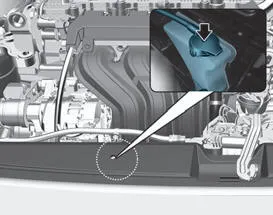
â– Smartstream G1.6
Check the condition and connections of all cooling system hoses and heater hoses. Replace any swollen, soft, or deteriorated hoses.
The coolant level should be between the F and the L marks on the side of the coolant reservoir when the engine is cool.
If the coolant level is low, add enough distilled (deionized) water to bring the level to the F mark, but do not overfill. If frequent additions are required, see an authorized HYUNDAI dealer for a cooling system inspection, as repeated topping-off may indicate a leak.
Recommended engine coolant
- When adding coolant, use only distilled (deionized) water for your vehicle and never mix hard water with the coolant filled at the factory.
- An improper coolant mixture can result in severe malfunction or engine damage.
- The engine in your Hyundai Accent has aluminum engine parts and must be protected by an ethylene-glycol with phosphate based coolant to help prevent corrosion and freezing.
- Do not use alcohol or methanol coolant or mix them with the specified coolant.
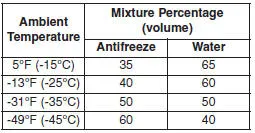
- Do not use a solution that contains more than 60% antifreeze or less than 35% antifreeze, which would reduce the effectiveness of the solution.
For mixing percentage, refer to the following table:
Information
If in doubt about the mix ratio, a 50% water and 50% antifreeze mix is the easiest to mix together as it will be the same quantity of each. It is suitable to use for most temperature ranges of - 31°F and higher.
WARNING

Never remove the engine coolant reservoir tank/radiator cap or the drain plug while the engine and radiator are hot. Hot coolant and steam may blow out under pressure, causing serious injury.
Turn the engine off and wait until the engine cools down. Use extreme care when removing the engine coolant reservoir tank/radiator cap. Wrap a thick towel around it, and turn it counterclockwise slowly to the first stop. Step back while the pressure is released from the cooling system. When you are sure all the pressure has been released, press down on the cap, using a thick towel, and continue turning counterclockwise to remove it.
WARNING

The electric motor for the cooling fan may continue to operate or start up when the engine is not running and can cause serious injury. Keep hands, clothing and tools away from the rotating fan blades of the cooling fan.
The electric motor for the cooling fan is controlled by engine coolant temperature, refrigerant pressure and vehicle speed. As the engine coolant temperature decreases, the electric motor will automatically shut off. This is a normal condition. If your vehicle is equipped with GDI, the electric motor for the cooling fan may begin to operate at any time and continue to operate until you disconnect the negative battery cable.
Changing Engine Coolant
Have coolant changed by an authorized HYUNDAI dealer according to the Maintenance Schedule at the beginning of this chapter. Using the correct coolant type helps maintain corrosion protection inside the Hyundai Accent cooling system.
WARNING
Do not use engine coolant or antifreeze in the washer fluid reservoir.
Engine coolant can severely obscure visibility when sprayed on the windshield and may cause loss of vehicle control resulting in an accident.
Engine coolant may also cause damage to paint and body trim.
NOTICE
To prevent damage to engine parts, put a thick towel around the radiator cap before refilling the coolant to prevent the coolant from overflowing into engine parts, such as the alternator.


Other information:
Hyundai Accent (HC) (2017 - 2022) Owner's Manual: CVVT & Camshaft
- Description Continuous Variable Valve Timing (CVVT) system advances or retards the valve timing of the intake and exhaust valve in accordance with the ECM control signal which is calculated by the engine speed and load.By controlling CVVT, the valve over-lap or under-lap occurs, which makes better fuel economy and reduces exhaust gases (NOx, HC) and improves engine performance through reduction of pumping loss, internal EGR effect, improvement of combustion stability, improvement of volumetric efficiency, and increase of expansion work.Hyundai Accent (HC) (2017 - 2022) Owner's Manual: Automatic climate control system
1. Temperature control knob 2. Fan speed control knob 3. AUTO (automatic control) button 4. Air intake control button 5. OFF button 6. Front windshield defrost button 7. Rear window defrost button 8. Mode selection button 9. Air conditioning button 10. Climate control information screen
Contents
Categories
- Manuals Home
- Hyundai Accent Owners Manual
- Hyundai Accent Service Manual
- Questions & Answers
- Video Guides
- Useful Resources
- New on site
- Most important about car
- Privacy Policy

0.0174