
Hyundai Accent (HC): Air bag - Advanced supplemental restraint system / Where Are the Air Bags?
Driver's and passenger's front air bags
Your vehicle is equipped with a Advanced Supplemental Restraint System (SRS) and lap/shoulder belts at both the driver and passenger seating positions. In the Hyundai Accent, these systems are engineered to work together, with the seat belt serving as the primary restraint.
The SRS consists of air bags which are located in the center of the steering wheel and the passenger's side front panel pad above the glove box.
The air bags are labeled with the letters "AIR BAG" embossed on the pad covers, making it easy to identify the Hyundai Accent air bag locations.
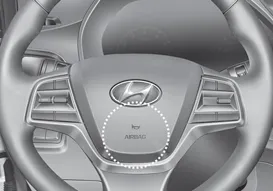
â– Driver's front air bag
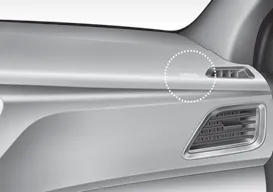
â– Passenger's front air bag
The purpose of the SRS is to provide the vehicle's driver and front passengers with additional protection than that offered by the seat belt system alone. The advanced SRS offers the ability to control the air bag inflation within two levels. A first stage level is provided for moderate-severity impacts.
A second stage level is provided for more severe impacts. This staged response helps the Hyundai Accent tailor deployment to certain crash severities.
According to the impact severity, the SRS Control Module (SRSCM) controls the air bag inflation. Failure to properly wear seat belts can increase the risk or severity of injury in an accident.
WARNING
To reduce the risk of serious injury or death from an inflating front air bags, take the following precautions:
- Seat belts must be worn at all times to help keep occupants positioned properly.
- Move your seat as far back as possible from front air bags, while still maintaining control of the vehicle.
- Never lean against the door or center console.
- Do not allow the front passenger to place their feet or legs on the dashboard.
- No objects (such as crash pad cover, cellular phone holder, cup holder, air fresheners or stickers) should be placed over or near the air bag modules on the steering wheel, instrument panel, windshield glass, and the front passenger's panel above the glove box. Such objects could cause harm if the vehicle is in a crash severe enough to cause the air bags to deploy.
Side air bags
The Hyundai Accent is equipped with advanced side air bag technology designed to enhance occupant protection during certain types of collisions. These systems work together with seat belts to help reduce the risk of serious injury in side impacts.
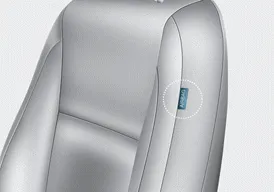
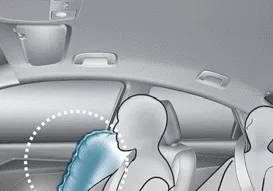
Your vehicle is equipped with a side air bag in each front seat. The purpose of the air bag is to provide the vehicle's driver and the front passenger with additional protection beyond that offered by the seat belt alone. In the Hyundai Accent, side air bags are integrated into the seat structure to deploy quickly and effectively when needed.
The side air bags are designed to deploy only during certain side impact collisions, depending on the crash severity and sensor input. This selective deployment helps limit unnecessary air bag activation.
The side and curtain air bags on both sides of the vehicle may deploy if a rollover or possible rollover is detected. In such events, the Hyundai Accent air bag system works to help protect occupants’ heads and upper bodies.
The side air bags are not designed to deploy in all side impact or rollover situations. In some crashes, the seat belts remain the primary restraint system providing occupant protection.
WARNING
To reduce the risk of serious injury or death from an inflating side air bag, take the following precautions:
- Seat belts must be worn at all times to help keep occupants positioned properly so the Hyundai Accent air bags can function as intended.
- Do not allow passengers to lean their heads or bodies onto doors, put their arms on the doors, stretch their arms out of the window, or place objects between the doors and seats.
- Hold the steering wheel at the 9 o'clock and 3 o'clock positions, to minimize the risk of injuries to your hands and arms during air bag deployment.
- Do not use any accessory seat covers. This could reduce or prevent the effectiveness of the side air bag system.
- Do not place any objects over the air bag or between the air bag and yourself. Also, do not attach any objects around the area the air bag inflates such as the door, side door glass, front and rear pillar.
- Do not place any objects between the door and the seat. They may become dangerous projectiles if the side air bag inflates.
- Do not install any accessories on the side or near the side air bags, as this may interfere with proper deployment.
- Do not put any objects between the side air bag label and seat cushion. It could cause harm if the vehicle is in a crash severe enough to cause the air bags to deploy.
- Do not cause impact to the doors when the ignition switch button is in the ON position, as this may cause the side air bags to inflate unintentionally.
- If the seat or seat cover is damaged, have the vehicle checked and repaired by an authorized HYUNDAI dealer to ensure continued Hyundai Accent safety performance.
Curtain air bags
The Hyundai Accent is equipped with curtain air bags designed to provide enhanced head protection for occupants during certain side impacts and rollover-related events. These air bags are part of the overall Supplemental Restraint System (SRS) and are engineered to work together with seat belts.
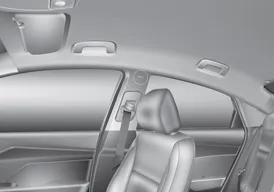
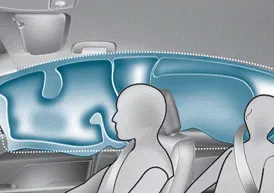
Curtain air bags are located along both sides of the roof rails above the front and rear doors. Their elevated mounting position allows them to deploy downward to help shield occupants’ heads.
They are designed to help protect the heads of the front seat occupants and the rear outboard seat occupants in certain side impact collisions. In the Hyundai Accent, this added coverage is especially important for reducing the risk of serious head injuries.
The curtain air bags are designed to deploy only during certain side impact collisions, depending on the crash severity as determined by the vehicle’s sensors.
The side and curtain air bags on both sides of the vehicle may deploy if a rollover or possible rollover is detected. In such cases, the Hyundai Accent curtain air bags may remain inflated longer to help reduce the risk of occupant ejection.
The curtain air bags are not designed to deploy in all side impact or rollover situations. In many accidents, seat belts remain the primary restraint system.
WARNING
To reduce the risk of serious injury or death from an inflating curtain air bag, take the following precautions:
- All seat occupants must wear seat belts at all times to help keep occupants positioned properly so the Hyundai Accent air bags can operate as designed.
- Properly secure child restraints as far away from the door as possible.
- Do not place any objects over the air bag. Also, do not attach any objects around the area the air bag inflates such as the door, side door glass, front and rear pillar, roof side rail.
- Do not hang other objects except clothes, especially hard or breakable objects. In an accident, it may cause vehicle damage or personal injury.
- Do not allow passengers to lean their heads or bodies onto doors, put their arms on the doors, stretch their arms out of the window, or place objects between the doors and seats.
- Do not open or repair the side curtain air bags. All service must be performed by an authorized HYUNDAI dealer.


Other information:
Hyundai Accent (HC) (2017 - 2022) Owner's Manual: Troubleshooting
- Basic Troubleshooting Basic Troubleshooting Guide Customer Problem Analysis Sheet Basic Inspection Procedure Measuring Condition Of Electronic Parts' Resistance The measured resistance at high temperature after vehicle running may be high or low. So all resistance must be measured at ambient temperature (20°C, 68°F), unless stated otherwise.Hyundai Accent (HC) (2017 - 2022) Owner's Manual: Stop Lamp Switch
- Components 1. Brake pedal member assembly2. Stop lamp switch3. Brake pedal arm 4. Pedal pad - Schematic Diagram - System circuit diagram - Terminal function TerminalDescription 1IGN 2BS 3- 4B+ 5BLS 6GND - Adjustment 1.Turn ignition switch OFF and disconnect the negative (-) battery cable. 2.Remove the lower crash pad.
Categories
- Manuals Home
- Hyundai Accent Owners Manual
- Hyundai Accent Service Manual
- Questions & Answers
- Video Guides
- Useful Resources
- New on site
- Most important about car
- Privacy Policy

0.0116