
Hyundai Accent (HC): Intelligent Variable Transmission (IVT) System (Continuously Variable Transmission) / Intelligent Variable Transmission (IVT)
Contents:
Components and Components Location
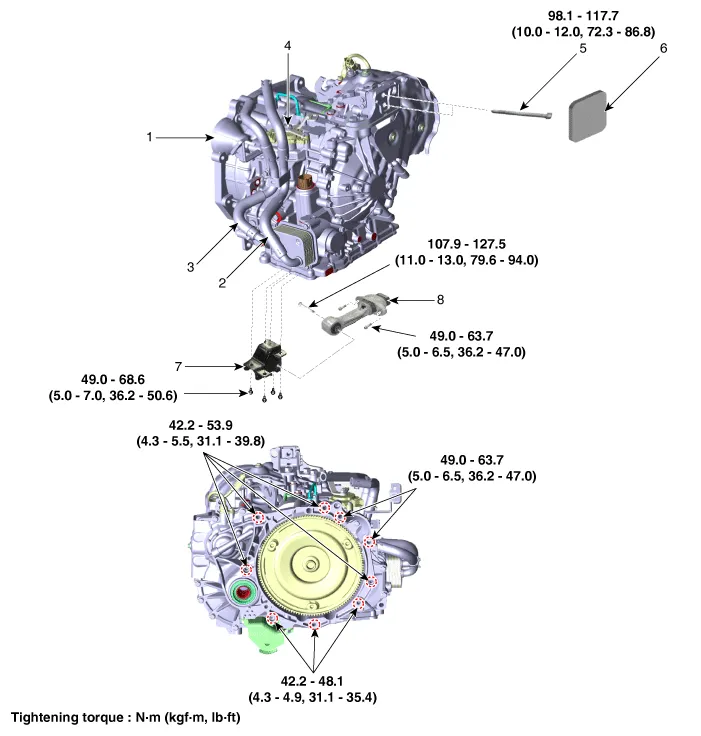
1. Intelligent variable transmission (IVT)
2. Coolant hose (IN)
3. Coolant hose (OUT)
4. Position switch
5. IVT support bracket mounting bolt
6. Cover
7. Roll rod support bracket
8. Roll rod bracket
Description and Operation
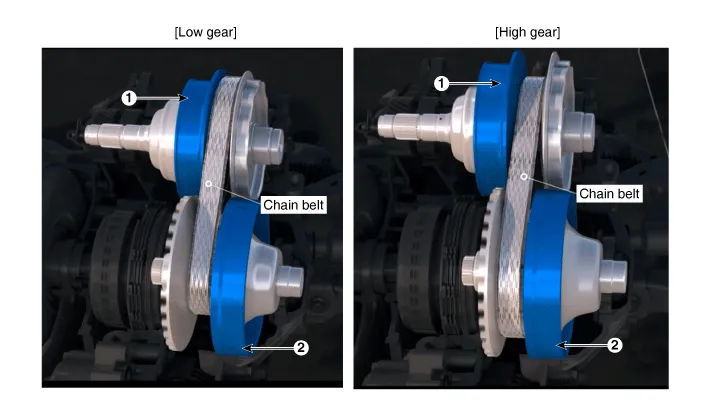
1. Driven Pulley (Output)
2. Drive Pulley (Input)
Repair procedures ➤
Oil Pan
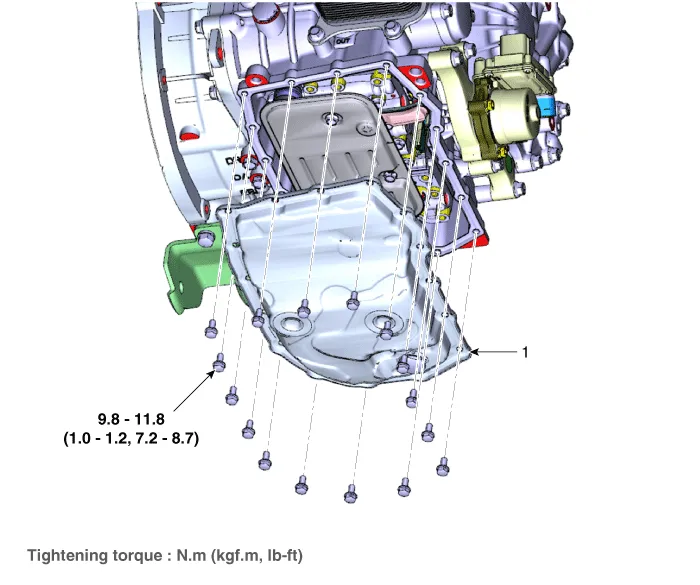
1. Oil pan
1.Remove the engine room under cover.(Refer to Engine Mechanical System - "Engine Room Under Cover")
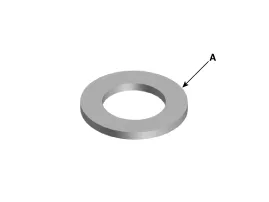
2.Remove the IVTF drain plug (A), allow the fluid to drain out and then reinstall the drain plug.
Tightening torque :34.3 - 44.1 N·m (3.5 - 4.5 kgf·m, 25.3 - 32.5 lb-ft)
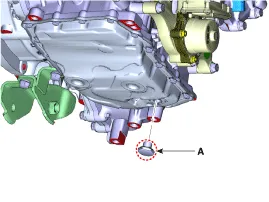

• Do not resuse gasket (A).
3.Remove the oil pan (A) after loosening the mounting bolts.
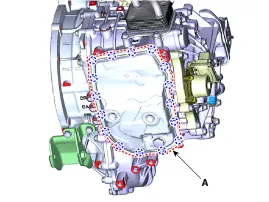

• Do not reuse the oil pan gasket.

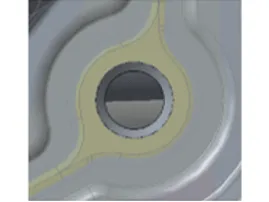
• When installing the oil pan install after visually matching the case/gasket/oil pan holes of the two standard holes (A).
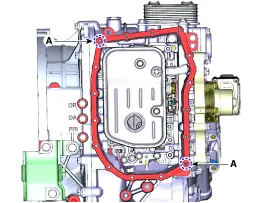
| Hole match: Assembly possible | Hole inconsistency: Oil leakage when assembled |
|
|

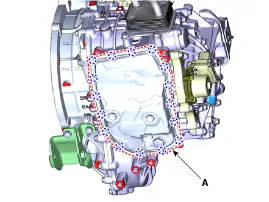
1.Install the oil pan (A).
Tightening torque :9.8 - 11.8 N·m (1.0 - 1.2 kgf·m, 7.2 - 8.7 lb-ft)
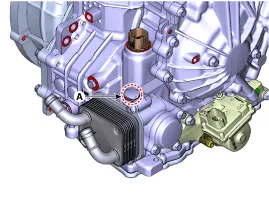
2.Loosen the injection plug (A) and supply IVTF.
Recommended rating : SP-CVT1Recommended oil : MICHANG SP-CVT1Oil quantity : 6.5 L (1.71 U.S.gal., 6.86 U.S.qt., 5.71 lmp.qt.)
3.Install the IVTF injection plug.
Tightening torque :34.3 - 44.1 N.m (3.5 - 4.5 kgf.m, 25.3 - 32.5 lb-ft)
4.Perform the IVTF level check procedure.(Refer to Hydraulic System - "Fluid")


Other information:
Hyundai Accent (HC) (2017 - 2022) Service Manual: Maintenance services
You should exercise the utmost care to prevent damage to your Hyundai Accent and injury to yourself whenever performing any maintenance or inspection procedures. Use proper tools, keep the engine compartment clean, and never work near moving parts with the engine running. Have your vehicle maintained and repaired by an authorized HYUNDAI dealer. An authorized HYUNDAI dealer meets HYUNDAI's high service quality standards and receives technical support from HYUNDAI in order to provide you with a high level of service satisfaction.Hyundai Accent (HC) (2017 - 2022) Service Manual: Troubleshooting
Standard Flow of Diagnostic Troubleshooting Notes With Regard To Diagnosis The phenomena listed in the following table are not abnormal.ConditionExplanation System check soundWhen starting the engine, a thudding sound can sometimes be heard coming from inside the engine compartment. This is because the system operation check is being performed.
Contents
Categories
- Manuals Home
- Hyundai Accent Owners Manual
- Hyundai Accent Service Manual
- Questions & Answers
- Video Guides
- Useful Resources
- New on site
- Most important about car
- Privacy Policy

0.0104