
Hyundai Accent (HC): Safety System of Your Vehicle / Seat belts
Contents:
- Seat Belt Safety Precautions
- Seat Belt Warning Light
- Seat Belt Restraint System
- Additional Seat Belt Safety Precautions
- Care of Seat Belts
This section describes how to use the seat belts properly. It also describes some of the things to avoid when using seat belts. In the Hyundai Accent, seat belts are the primary restraint system, and correct use is essential for every trip, even short drives.
Seat Belt Safety Precautions
Always fasten your seat belt and make sure all passengers have fastened their seat belts before starting any trip. Air bags are designed to supplement the seat belt as an additional safety device, but they are not a substitute. Most states require all occupants of a vehicle to wear seat belts. For Hyundai Accent safety, ensure the lap portion is low and snug across the hips and the shoulder portion crosses the center of the chest.
WARNING
Seat belts must be used by ALL passengers whenever the vehicle is moving.Take the following precautions when adjusting and wearing seat belts:
- ALWAYS properly restrain children under age 13 in the rear seats.
- NEVER allow children to ride in the front passenger seat. If a child age 13 or older must be seated in the front seat, move the seat as far back as possible and properly restrain them in the seat.
- NEVER allow an infant or child to be carried on an occupant’s lap.
- NEVER ride with the seatback reclined when the vehicle is moving.
- Do not allow children to share a seat or seat belt.
- Do not wear the shoulder belt under your arm or behind your back.
- Always wear both the shoulder portion and lap portion of the lap/shoulder belt.
- Do not use the seat belt if it is twisted. A twisted seat belt will not protect you properly in an accident.
- Do not use a seat belt if the webbing or hardware is damaged.
- Do not latch the seat belt into the buckles of other seats.
- NEVER unfasten the seat belt while driving. This may cause loss of vehicle control resulting in an accident.
- Make sure there is nothing in the buckle interfering with the seat belt latch mechanism. This may prevent the seat belt from fastening securely.
- No modifications or additions should be made by the user which will either prevent the seat belt adjusting devices from operating to remove slack, or prevent the seat belt assembly from being adjusted to remove slack. Only use Hyundai Accent approved parts and service procedures.
WARNING
Damaged seat belts and seat belt assemblies will not operate properly. Always replace:
- Frayed, contaminated, or damaged webbing
- Damaged hardware
- The entire seat belt assembly after it has been worn in an accident, even if damage to webbing or assembly is not apparent
Seat Belt Warning Light
Seat belt warning light
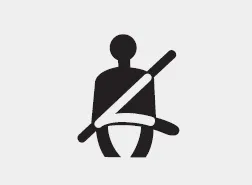
As a reminder to the driver, the seat belt warning light will illuminate for approximately 6 seconds each time you place the ignition switch to the ON position regardless of belt fastening. However, if the seat belt is unfasted, a warning chime will sound for approximately 6 seconds. This reminder is designed to encourage proper Hyundai Accent seat belt use before the vehicle moves.
If you continue not to fasten the seat belt and you drive over 6 mph (9 km/h), the warning light will stay illuminated.
If you continue not to fasten the seat belt and you drive over 12 mph (20 km/h) the seat belt warning chime will sound for approximately 100 seconds and the corresponding warning light will blink.
If you unfasten the seat belt while driving under 12 mph (20 km/h), the seat belt warning light will illuminate until the seat belt is fastened.
If you unfasten the seat belt while driving over 12 mph (20 km/h), the seat belt warning chime will sound for approximately 100 seconds and the corresponding warning light will blink.
Seat Belt Restraint System ➤
Additional Seat Belt Safety Precautions
For maximum occupant protection in the Hyundai Accent, it is essential to follow additional seat belt safety precautions in special situations such as pregnancy, transporting children, or assisting injured passengers. Correct seat belt use helps the Hyundai Accent restraint systems function as designed.
Seat belt use during pregnancy
The seat belt should always be used during pregnancy. The best way to protect your unborn child is to protect yourself by always wearing the seat belt. Proper belt positioning in the Hyundai Accent significantly reduces the risk of injury during sudden stops or collisions.
Pregnant women should always wear a lap-shoulder seat belt. Place the shoulder belt across your chest, routed between your breasts and away from your neck. Place the lap belt line so that it fits snugly and as low as possible across the hips, not across the abdomen. This positioning helps keep pressure away from the unborn child while driving the Hyundai Accent.
WARNING
- A pregnant woman or a patient is more vulnerable to any impacts on the abdomen during an abrupt stop or accident. If you are in an accident while pregnant, consult your doctor.
- To reduce the risk of serious injury or death to an unborn child during an accident, pregnant women should NEVER place the lap portion of the seat belt above or over the area of the abdomen where the unborn child is located.
Seat belt use and children
Infant and small children
All 50 states have child restraint laws which require children to travel in approved child restraint devices, including booster seats. The age at which seat belts can be used instead of child restraints differs among states, so you should be aware of the specific requirements in your state, and where you are travelling. In the Hyundai Accent, infant and child restraints must always be properly placed and installed in a rear seat. For more information refer to the "Child Restraint Systems" section in this chapter.
WARNING
ALWAYS properly restrain infants and small children in a child restraint appropriate for the child's height and weight.
To reduce the risk of serious injury or death to a child and other passengers, NEVER hold a child in your lap or arms when the vehicle is moving. The violent forces created during an accident will tear the child from your arms and throw the child against the interior of the vehicle.
Small children are best protected from injury in an accident when properly restrained in the rear seat by a child restraint system that meets the requirements of the Federal Motor Vehicle Safety Standards. Before buying any child restraint system, make sure that it has a label certifying that it meets Federal Motor Vehicle Safety Standard FMVSS 213. The restraint must be appropriate for your child’s height and weight. Check the label on the child restraint for this information. Refer to the "Child Restraint Systems" section in this chapter. Correct CRS use is especially important in the Hyundai Accent due to its compact cabin design.
Larger children
Children under age 13 and who are too large for a booster seat must always occupy the rear seat and use the available lap/shoulder belts. A seat belt should lie across the upper thighs and be snug across the shoulder and chest to restrain the child safely. Check belt fit periodically as children grow. Children are afforded the most safety in the event of an accident when they are restrained by a proper restraint system and/or seat belts in the rear seat of the Hyundai Accent.
Always have the LATCH system inspected by your authorized HYUNDAI dealer after an accident. An accident can damage the LATCH system and may not properly secure the child restraint.
If a larger child over age 13 must be seated in the front seat, the child must be securely restrained by the available lap/shoulder belt and the seat should be placed in the rearmost position to reduce injury risk in the Hyundai Accent.
If the shoulder belt portion slightly touches the child's neck or face, try placing the child closer to the center of the vehicle. If the shoulder belt still touches their face or neck they need to be returned to an appropriate booster seat in the rear seat.
WARNING
- Always make sure children are wearing their seat belts and that they are properly adjusted before driving.
- NEVER allow the shoulder belt to contact the child’s neck or face.
- Do not allow more than one child to use a single seat belt.
Transporting an injured person
A seat belt should be used when an injured person is being transported. Consult a physician for specific recommendations. In the Hyundai Accent, proper restraint can help prevent additional injuries during transport.
One person per belt
Two people (including children) should never attempt to use a single seat belt. This could increase the severity of injuries in case of an accident and prevent the Hyundai Accent seat belt system from working correctly.
Do not lie down
Sitting in a reclined position when the vehicle is in motion can be dangerous. Even when buckled up, the protections of your restraint system (seat belts and air bags) is greatly reduced by reclining your seatback.
To reduce the chance of injuries in the event of an accident and to achieve the maximum effectiveness of the restraint system, all passengers should be sitting up and the front and rear seats should be in an upright position when the car is moving. This seating posture allows the Hyundai Accent safety systems to function as designed.
A seat belt cannot provide proper protection if the person is lying down in the rear seat or if the front or rear seats are in a reclined position.
WARNING
- NEVER ride with a reclined seatback when the vehicle is moving.
- Riding with a reclined seatback increases your chance of serious or fatal injuries in the event of a collision or sudden stop.
- Drivers and passengers should always sit well back in their seats, properly belted, and with the seatbacks upright.
Care of Seat Belts
Seat belt systems should never be disassembled or modified. In addition, care should be taken to assure that seat belts and belt hardware are not damaged by seat hinges, doors or other abuse. Proper care helps maintain long-term reliability in the Hyundai Accent.
Periodic inspection
All seat belts should be inspected periodically for wear or damage of any kind. Any damaged parts should be replaced as soon as possible by an authorized HYUNDAI dealer to maintain Hyundai Accent safety standards.
Keep belts clean and dry
Seat belts should be kept clean and dry. If belts become dirty, they can be cleaned by using a mild soap solution and warm water. Bleach, dye, strong detergents or abrasives should not be used because they may damage and weaken the fabric.
When to replace seat belts
The entire seat belt assembly or assemblies should be replaced if the vehicle has been involved in an accident. This should be done even if no damage is visible. Additional questions concerning seat belt operation should be directed to an authorized HYUNDAI dealer.


Other information:
Hyundai Accent (HC) (2017 - 2022) Owner's Manual: Phone
Information - Using Bluetooth® Wireless Technology(BT) Cellular Phone Bluetooth® Wireless Technology is a near-field wireless networking technology that uses the 2.4 GHz frequency to connect various devices within a certain distance wirelessly. In the Hyundai Accent, Bluetooth® Wireless Technology supports handsfree calling and (when compatible) media streaming.Hyundai Accent (HC) (2017 - 2022) Owner's Manual: Stop Lamp Switch
- Components 1. Brake pedal member assembly2. Stop lamp switch3. Brake pedal arm 4. Pedal pad - Schematic Diagram - System circuit diagram - Terminal function TerminalDescription 1IGN 2BS 3- 4B+ 5BLS 6GND - Adjustment 1.Turn ignition switch OFF and disconnect the negative (-) battery cable. 2.Remove the lower crash pad.
Contents
- Seat Belt Safety Precautions
- Seat Belt Warning Light
- Seat Belt Restraint System
- Additional Seat Belt Safety Precautions
- Care of Seat Belts
Categories
- Manuals Home
- Hyundai Accent Owners Manual
- Hyundai Accent Service Manual
- Questions & Answers
- Video Guides
- Useful Resources
- New on site
- Most important about car
- Privacy Policy

0.0128