
Hyundai Accent (HC): Infotainment System / Winter driving
Contents:
The severe weather conditions of winter can quickly wear out tires and create additional challenges such as reduced traction, longer stopping distances, and limited visibility. To minimize winter driving problems in your Hyundai Accent, prepare the vehicle in advance and adjust your driving habits to match the road surface and the weather.
Snow or Icy Conditions
You need to keep sufficient distance between your vehicle and the vehicle in front of you. On snow or ice, the Hyundai Accent may require significantly more space to stop than on dry pavement, so increase following distance and plan for earlier braking.
Apply the brakes gently. Speeding, rapid acceleration, sudden brake applications, and sharp turns are potentially very hazardous practices. During deceleration, use engine braking to the fullest extent where appropriate, and avoid abrupt steering inputs that can cause the vehicle to skid on snowy or icy roads.
To drive your vehicle in deep snow, it may be necessary to use snow tires or to install tire chains on your tires, depending on tire size, local regulations, and current road conditions. Choose the option that best matches the winter conditions you expect to encounter with your Hyundai Accent.
Always carry emergency equipment during winter travel. Some of the items you may want to carry include tire chains, tow straps or chains, a flashlight with spare batteries, emergency flares, sand, a shovel, jumper cables, a window scraper, gloves, ground cloth, coveralls, a blanket, and other supplies appropriate for your area.
Snow tires
WARNING
Snow tires should be equivalent in size and type to the vehicle’s standard tires. Otherwise, the safety and handling of your vehicle may be adversely affected.
If you mount snow tires on your vehicle, make sure to use radial tires of the same size and load range as the original tires. Mount snow tires on all four wheels to balance your vehicle’s handling in all weather conditions. The traction provided by snow tires on dry roads may not be as high as your Hyundai Accent's original equipment tires. Check with the tire dealer for maximum speed recommendations and follow those recommendations.
Information
Do not install studded tires without first checking local, state and municipal regulations for possible restrictions against their use.
Tire chains
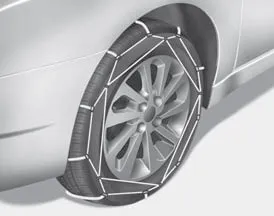
Since the sidewalls of radial tires are thinner than other types of tires, they may be damaged by mounting some types of tire chains on them. Therefore, the use of snow tires is recommended instead of tire chains. Do not mount tire chains on vehicles equipped with aluminum wheels; if unavoidable use a wire type chain. If tire chains must be used, use genuine HYUNDAI parts and install the tire chain after reviewing the instructions provided with the tire chains. Damage to your vehicle caused by improper tire chain use is not covered by your vehicle manufacturer’s warranty. For the best results, confirm chain clearance and fitment for your specific Hyundai Accent tire size before winter conditions arrive, and always recheck chain tension after moving a short distance.
WARNING
The use of tire chains may adversely affect vehicle handling:
- Drive less than 20 mph (30 km/h) or the chain manufacturer's recommended speed limit, whichever is lower.
- Drive carefully and avoid bumps, holes, sharp turns, and other road hazards, which may cause the vehicle to bounce.
- Avoid sharp turns or locked wheel braking.
CAUTION
If your vehicle has 205/45 R17 size tires do not use tire chain; they can damage your vehicle (wheel, suspension and body).
Information
- Install tire chains on both left and right front tires. It should be noted that installing tire chains on the tires will provide a greater driving force, but will not prevent side skids.
- Do not install studded tires without first checking local, state and municipal regulations for possible restrictions against their use.
Chain installation
When installing tire chains, follow the manufacturer’s instructions and mount them as tightly possible. Drive slowly (less than 20 mph (30 km/h)) with chains installed. If you hear the chains contacting the body or chassis, stop and tighten them. If they still make contact, slow down until the noise stops. Remove the tire chains as soon as you begin driving on cleared roads.
When mounting snow chains, park the vehicle on level ground away from traffic. Turn on the vehicle Hazard Warning Flasher and place a triangular emergency warning device behind the vehicle (if available). Always place the vehicle in P (Park), apply the parking brake and turn off the engine before installing snow chains. In very cold conditions, wearing gloves can help you tighten chains securely and safely.
NOTICE
- When using tire chains:
- Wrong size chains or improperly installed chains can damage your vehicle's brake lines, suspension, body and wheels.
- Use SAE "S" class or wire chains.
- If you hear noise caused by chains contacting the body, retighten the chain to prevent contact with the vehicle body.
- To prevent body damage, retighten the chains after driving 0.3~0.6 miles (0.5~1.0 km).
- Do not use tire chains on vehicles equipped with aluminum wheels. If unavoidable, use a wire type chain.
- Use wire chains less than 0.47 inch (12 mm) wide to prevent damage to the chain’s connection.
Winter Precautions
Use high quality ethylene glycol coolant
Your vehicle is delivered with high quality ethylene glycol coolant in the cooling system. It is the only type of coolant that should be used because it helps prevent corrosion in the cooling system, lubricates the water pump and prevents freezing. Be sure to replace or replenish your coolant in accordance with the maintenance schedule in chapter 7. Before winter, have your coolant tested to assure that its freezing point is sufficient for the temperatures anticipated during the winter. Proper coolant concentration is especially important for winter driving because it helps protect the Hyundai Accent against freezing and overheating, and it supports consistent heater performance.
Change to "winter weight" oil if necessary
In some climates it is recommended that a lower viscosity "winter weight" oil be used during cold weather. See chapter 8 for recommendations. If you aren't sure what weight oil you should use, consult an authorized HYUNDAI dealer.
Check battery and cables
Winter puts additional burdens on the battery system. Visually inspect the battery and cables as described in chapter 7. The level of charge in your battery can be checked by an authorized HYUNDAI dealer or a service station. Clean terminals and secure connections can help your Hyundai Accent crank more easily on cold mornings.
Check spark plugs and ignition system
Inspect your spark plugs as described in chapter 7 and replace them if necessary. Also check all ignition wiring and components to be sure they are not cracked, worn or damaged in any way.
Use approved window washer anti-freeze in system
To keep the water in the window washer system from freezing, add an approved window washer anti-freeze solution in accordance with instructions on the container.Window washer anti-freeze is available from an authorized HYUNDAI dealer and most auto parts outlets. Do not use engine coolant or other types of antifreeze as these may damage the paint finish.
Do not let your parking brake freeze
Under some conditions your parking brake can freeze in the engaged position. This is most likely to happen when there is an accumulation of snow or ice around or near the rear brakes or if the brakes are wet. If there is a risk the parking brake may freeze, apply it only temporarily while you put the gear selector lever in P and block the rear wheels so the car cannot roll. Then release the parking brake.
Do not let ice and snow accumulate underneath
Under some conditions, snow and ice can build up under the fenders and interfere with the steering. When driving in severe winter conditions where this may happen, you should periodically check underneath the car to be sure the movement of the front wheels and the steering components is not obstructed.
Don't place foreign objects or materials in the engine compartment
Placement of foreign object or materials which prevent cooling of the engine, in the engine compartment, may cause a failure or combustion. The manufacturer is not responsible for the damage caused by such placement.
To keep locks from freezing
To keep the locks from freezing, squirt an approved de-icer fluid or glycerine into the key opening. If a lock is covered with ice, squirt it with an approved de-icing fluid to remove the ice. If the lock is frozen internally, you may be able to thaw it out by using a heated key. Handle the heated key with care to avoid injury.
Information
As an extra winter tip for the Hyundai Accent, clear snow from the roof, hood, lights, and windows before driving, and recheck tire pressures often because pressure can drop as temperatures fall.


Other information:
Hyundai Accent (HC) (2017 - 2022) Owner's Manual: Vehicle load limit
Two labels on your driver’s door sill show how much weight your Hyundai Accent was designed to carry: the Tire and Loading Information Label and the Certification Label. These labels help you confirm safe loading limits before you add passengers or cargo. Before loading your Hyundai Accent, familiarize yourself with the following terms for determining your vehicle’s weight ratings, based on the vehicle specifications and the Certification Label: Base Curb Weight This is the weight of the vehicle including a full tank of fuel and all standard equipment.Hyundai Accent (HC) (2017 - 2022) Owner's Manual: Instrument cluster
â– Type A â– Type B 1. Tachometer 2. Speedometer 3. Engine coolant temperature gauge 4. Fuel gauge 5.Warning and indicator lights 6. LCD display (including Trip computer)
Contents
Categories
- Manuals Home
- Hyundai Accent Owners Manual
- Hyundai Accent Service Manual
- Questions & Answers
- Video Guides
- Useful Resources
- New on site
- Most important about car
- Privacy Policy

0.0051