
Hyundai Accent (HC): Maintenance / Tires and wheels
Contents:
- Tire Care
- Recommended Cold Tire Inflation Pressures
- Check Tire Inflation Pressure
- Tire Rotation
- Wheel Alignment and Tire Balance
- Tire Replacement
- Tire Terminology and Definitions
- All Season Tires
- Summer Tires
- Snow Tires
- Radial-Ply Tires
- Low Aspect Ratio Tires
WARNING
Tire failure may cause loss of vehicle control resulting in an accident. To reduce risk of SERIOUS INJURY or DEATH, take the following precautions:
- Inspect your tires monthly for proper inflation as well as wear and damage.
- The recommended cold tire pressure for your vehicle can be found in this manual and on the tire label located on the driver's side center pillar. Always use a tire pressure gauge to measure tire pressure. Tires with too much or too little pressure wear unevenly causing poor handling.
- Check the pressure of the spare every time you check the pressure of the other tires on your vehicle.
- Replace tires that are worn, show uneven wear, or are damaged. Worn tires can cause loss of braking effectiveness, steering control, or traction.
- ALWAYS replace tires with the same size as each tire that was originally supplied with this vehicle. Using tires and wheels other than the recommended sizes could cause unusual handling characteristics, poor vehicle control, or negatively affect your vehicle's Anti-Lock Brake System (ABS) resulting in a serious accident.
Tire Care
For proper maintenance, safety, and maximum fuel economy, you must always maintain recommended tire inflation pressures and stay within the load limits and weight distribution recommended for your vehicle. Consistent tire care is especially important for a Hyundai Accent because correct pressures support predictable handling and help warning systems such as TPMS provide accurate information.
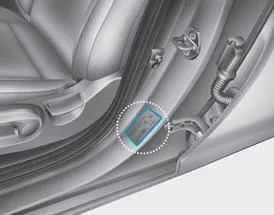
All specifications (sizes and pressures) can be found on a label attached to the driver's side center pillar.
Recommended Cold Tire Inflation Pressures
All tire pressures (including the spare) should be checked when the tires are cold. "Cold tires" means the vehicle has not been driven for at least three hours or has been driven for less than one mile (1.6 km).
Warm tires normally exceed recommended cold tire pressures by 4 to 6 psi (28 to 41 kPa). Do not release air from warm tires to adjust the pressure or the tires will be under-inflated. For recommended inflation pressure, refer to "Tire and Wheels" in chapter 8.
WARNING
Recommended pressures must be maintained for the best ride, vehicle handling, and minimum tire wear.
Over-inflation or under-inflation can reduce tire life, adversely affect vehicle handling, and lead to sudden tire failure that could result in loss of vehicle control resulting in an accident. Severe under-inflation can lead to severe heat build-up, causing blowouts, tread separation and other tire failures that can result in the loss of vehicle control resulting in an accident. This risk is much higher on hot days and when driving for long periods at high speeds.
CAUTION
- Under-inflation results in excessive wear, poor handling and reduced fuel economy. Wheel deformation is also possible. Keep your tire pressures at the proper levels. If a tire frequently needs refilling, have it checked by an authorized HYUNDAI dealer.
- Over-inflation produces a harsh ride, excessive wear at the center of the tire tread, and a greater possibility of damage from road hazards.
Check Tire Inflation Pressure
Check your tires, including the spare tire, once a month or more.
How to check
Use a good quality tire pressure gauge to check tire pressure. You can not tell if your tires are properly inflated simply by looking at them. Radial tires may look properly inflated when they are under-inflated.
Remove the valve cap from the tire valve stem. Press the tire gauge firmly onto the valve to get a pressure measurement. If the cold tire inflation pressure matches the recommended pressure on the tire label located on the driver's side center pillar or in this manual. No further adjustment is necessary. If the pressure is low, add air until you reach the recommended pressure. Make sure to put the valve caps back on the valve stems. Without the valve cap, dirt or moisture could get into the valve core and cause air leakage. If a valve cap is missing, install a new one as soon as possible.
If you overfill the tire, release air by pushing on the metal stem in the center of the tire valve. Recheck the tire pressure with the tire gauge. Be sure to put the valve caps back on the valve stems. Without the valve cap, dirt or moisture could get into the valve core and cause air leakage. If a valve cap is missing, install a new one as soon as possible.
A cold tire means the vehicle has been sitting for 3 hours and driven for less than 1 mile (1.6 km) in that 3 hour period.
Allow the tire to cool before measuring the inflation pressure. Always be sure the tire is cold before inflating to the recommended pressure.
Tire Rotation
To equalize tread wear, have the tires rotated according to the maintenance schedule or sooner if irregular wear develops.
During rotation, check the tires for correct balance.
When rotating tires, check for uneven wear and damage. Abnormal wear is usually caused by incorrect tire pressure, improper wheel alignment, outof-balance wheels, severe braking or severe cornering. Look for bumps or bulges in the tread or side of the tire. Replace the tire if you find any of these conditions. Replace the tire if fabric or cord is visible. After rotation, be sure to bring the front and rear tire pressures to specification and check lug nut tightness (proper torque is 79~94 lbf·ft [11~13 kgf·m]).
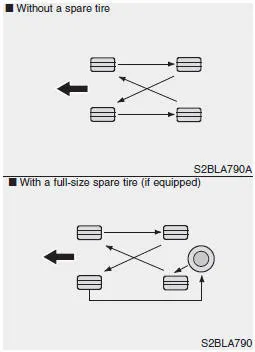
Disc brake pads should be inspected for wear whenever tires are rotated.
Information
Tires that are asymmetrical or directional can only be installed on the wheel in one direction. The outside and inside of an asymmetrical tire is not easily distinguishable. Pay careful attention to the markings on the sidewalls of the tires, noting the "outside" marking and also the rotating direction before installing them on the vehicle.
WARNING
- Do not use the compact spare tire for tire rotation.
- Do not mix bias ply and radial ply tires under any circumstances. This may cause unusual handling characteristics that may cause loss of vehicle control resulting in an accident.
Wheel Alignment and Tire Balance
The wheels on your Hyundai Accent were aligned and balanced precisely at the factory to help provide the longest possible tire life, smooth ride quality, and strong overall handling performance.
In most day-to-day driving situations, you will not need to have the wheel alignment adjusted again. However, if you notice unusual or uneven tire wear, the Hyundai Accent pulling to the left or right, or the steering wheel no longer sitting straight when you are driving on a level road, the alignment may need to be inspected and corrected.
If you feel vibration while driving on a smooth road—especially through the steering wheel, seat, or floor—your wheels and tires may need to be rebalanced. Proper balancing improves comfort, reduces stress on suspension components, and can help prevent premature tire wear.
As a practical add-on for Hyundai Accent maintenance, consider having alignment and balance checked after a hard impact (such as a pothole or curb strike), after suspension/steering repairs, or whenever installing new tires, since small changes can affect tire wear and straight-line stability.
NOTICE
Improper wheel weights can damage your vehicle's aluminum wheels. Use only approved wheel weights and correct mounting methods.
Tire Replacement ➤
Tire Terminology and Definitions
Air Pressure
The amount of air inside the tire pressing outward on the tire structure. Air pressure is expressed in pounds per square inch (psi) or kilopascals (kPa) and directly affects ride comfort, handling, and tire life on a Hyundai Accent.
Accessory Weight
The combined weight of optional accessories installed on the vehicle. Examples include intelligent variable transmission (IVT), power seats, and air conditioning systems.
Aspect Ratio
The relationship of a tire's section height to its width, expressed as a percentage.
Belt
A rubber-coated layer of cords located between the plies and the tread. Belts may be made from steel or other reinforcing materials to improve strength and stability.
Bead
The tire bead contains steel wires wrapped by steel cords that hold the tire securely against the rim.
Bias Ply Tire
A pneumatic tire in which the plies are laid at alternating angles less than 90 degrees to the centerline of the tread.
Cold Tire Pressure
The amount of air pressure in a tire measured before the tire has built up heat from driving, expressed in psi or kPa.
Curb Weight
The weight of a motor vehicle with standard and optional equipment, including maximum fuel, oil, and coolant levels, but without passengers or cargo.
DOT Markings
A code molded into the sidewall of a tire indicating compliance with U.S. Department of Transportation motor vehicle safety standards. The DOT code includes the Tire Identification Number (TIN), which identifies the tire manufacturer, production plant, brand, and production date.
GVWR
Gross Vehicle Weight Rating.
GAWR FRT
Gross Axle Weight Rating for the front axle.
GAWR RR
Gross Axle Weight Rating for the rear axle.
Intended Outboard Sidewall
The side of an asymmetrical tire that must always face outward when mounted on a vehicle.
Kilopascal (kPa)
The metric unit used to measure air pressure.
Light truck (LT) tire
A tire designated by its manufacturer as primarily intended for use on lightweight trucks or multipurpose passenger vehicles.
Load ratings
The maximum load that a tire is rated to carry for a given inflation pressure.
Load Index
An assigned numerical code ranging from 1 to 279 that corresponds to the load-carrying capacity of a tire.
Maximum Inflation Pressure
The maximum air pressure to which a cold tire may be inflated, molded onto the tire sidewall.
Maximum Load Rating
The maximum load a tire can carry at its maximum permissible inflation pressure.
Maximum Loaded Vehicle Weight
The total of curb weight, accessory weight, vehicle capacity weight, and production options weight.
Normal Occupant Weight
The number of occupants a vehicle is designed to seat multiplied by 150 pounds (68 kg).
Occupant Distribution
The designated seating positions within the vehicle.
Outward Facing Sidewall
The side of an asymmetrical tire that faces outward when mounted, often marked with white lettering or more prominent branding.
Passenger (P-Metric) tire
A tire designed for use on passenger cars and some light-duty trucks and multipurpose vehicles, including the Hyundai Accent.
Ply
A layer of rubber-coated parallel cords that form the tire’s internal structure.
Pneumatic tire
A tire made of rubber, chemicals, fabric, and steel or other materials that provides traction and contains air or fluid to support vehicle load.
Pneumatic options weight
The combined weight of installed production options exceeding 5 lb (2.3 kg) beyond standard equipment, such as heavy-duty brakes, roof racks, or larger batteries.
Recommended Inflation Pressure
The tire inflation pressure recommended by the vehicle manufacturer and shown on the vehicle placard.
Radial Ply Tire
A pneumatic tire in which the ply cords extend to the beads at 90 degrees to the centerline of the tread.
Rim
The metal support on which the tire beads are seated.
Sidewall
The portion of a tire between the tread and the bead.
Speed Rating
An alphanumeric code indicating the maximum speed capability of a tire when properly inflated and loaded.
Traction
The friction between the tire and the road surface, determining the level of grip.
Tread
The part of the tire that comes into direct contact with the road surface.
Treadwear Indicators
Narrow bands, also known as wear bars, that become visible across the tread when only 1/16 inch of tread depth remains.
UTQGS
Uniform Tire Quality Grading Standards, a system that provides ratings for traction, temperature, and treadwear based on government testing procedures.
Vehicle Capacity Weight
The total of designated seating capacity multiplied by 150 lb (68 kg) plus rated cargo and luggage load.
Vehicle Maximum Load on the Tire
The load on an individual tire due to curb weight, accessory weight, and maximum occupant and cargo weight.
Vehicle Normal Load on the Tire
The load on an individual tire calculated by distributing curb weight, accessory weight, and normal occupant weight equally across axles.
Vehicle Placard
A permanent label on the vehicle showing original equipment tire size and recommended inflation pressure.
All Season Tires
HYUNDAI specifies all season tires on some models to deliver reliable year-round performance, including moderate snow and icy road conditions. All season tires are marked with ALL SEASON and/or M+S (Mud and Snow) on the sidewall. While suitable for most climates, snow tires may provide better traction in severe winter conditions.
Summer Tires
HYUNDAI specifies summer tires on some models to provide superior handling and grip on dry and wet roads. Summer tire performance is greatly reduced in snow and ice, and these tires do not carry the M+S marking. For Hyundai Accent operation in cold or snowy climates, switch to all season or dedicated snow tires on all four wheels.
Snow Tires
If your vehicle is equipped with snow tires, they should be the same size and load capacity as the original tires. Snow tires must be installed on all four wheels to maintain balanced handling. Inflate snow tires to 4 psi (28 kPa) above the standard tire pressure shown on the driver’s side center pillar, without exceeding the maximum pressure listed on the tire sidewall. Do not exceed 75 mph (120 km/h) when driving with snow tires installed.
Radial-Ply Tires
Radial-ply tires are engineered to provide improved tread life, stronger resistance to many common road hazards, and a smoother ride at higher speeds. The radial-ply tires installed on your Hyundai Accent use a belted construction and are chosen to complement the ride comfort, steering response, and handling balance designed into the Hyundai Accent.
Radial-ply tires generally have the same load-carrying capacity as bias-ply or bias-belted tires of the same size, and they use the same recommended inflation pressures specified for your Hyundai Accent. However, mixing radial-ply tires with bias-ply or bias-belted tires is not recommended. Any combination of different tire constructions on the same vehicle can seriously deteriorate vehicle handling and stability. As a best practice, use identical pairs of radial-ply tires on the front axle and another identical pair on the rear axle so the vehicle responds consistently in braking, cornering, and emergency maneuvers.
Some longer-wearing tires can be more susceptible to irregular tread wear if maintenance is neglected. To achieve the best tread-life potential from your Hyundai Accent tires, follow the tire rotation interval in this chapter and maintain the recommended cold tire pressure. Cuts and punctures in radial-ply tires are repairable only in the tread area due to sidewall flexing. Consult your tire dealer or service professional for proper radial-ply tire inspection and repair.
As a helpful add-on for Hyundai Accent tire care, inspect the tire sidewalls after pothole impacts, curb contact, or road debris strikes. Even if the tread looks acceptable, sidewall damage can lead to slow air loss or a later failure.
WARNING
Do not mix bias ply and radial ply tires under any circumstances. This may cause unusual handling characteristics that may cause loss of vehicle control resulting in an accident.
Low Aspect Ratio Tires
Low aspect ratio tires are identified by an aspect ratio below 50. This means the tire’s sidewall is shorter relative to its width compared with a standard tire.
Because low aspect ratio tires are optimized for sharper handling and stronger braking feel, their sidewalls are typically stiffer than conventional tires. They are often wider as well, which can increase the tire’s contact patch with the road surface. In some situations, this may also increase road noise compared with standard tires—this can be normal depending on the Hyundai Accent wheel and tire package and the road surface.
CAUTION
Because the sidewall of a low aspect ratio tire is shorter than a standard tire, the rim of the wheel and the tire itself is more easily susceptible to damage. Use caution when driving and follow the guidelines below to help minimize damage to the wheel and tire:
- When driving on a rough road or off road, drive cautiously because tires and wheels may be damaged. And after driving, inspect tires and wheels.
- When passing over a pothole, speed bump, manhole, or curb stone, drive slowly so that the tires and wheels are not damaged.
- If the tire is subjected to a severe impact, have the tire and wheel inspected by an authorized HYUNDAI dealer.
- Inspect the tire condition and pressure every 1,800 miles (3,000km).
CAUTION
- It is not easy to recognize tire damage with your own eyes. But if there is the slightest hint of tire damage, have the tire checked or replaced because the tire damage may cause air leakage from the tire.
- If the tire is damaged by driving on a rough road, off road, pothole, manhole, or curb stone, it will not be covered by the warranty.


Other information:
Hyundai Accent (HC) (2017 - 2022) Owner's Manual: Description and Operation
- Function NoItemDescription 1Washer Linked Wiper – If the washer switch is pressed ON for 0.06 second with the vehicle mode in IGN2, the wiper relay is turned ON after washer switch ON, and then the wiper relay is turned OFF after wiper parking signal ON. 2MIST Linked Wiper – If the wiper mist switch is pressed ON for 0.6 second with the vehicle mode in IGN2, the wiper relay is turned ON, and then OFF after wiper parking signal ON.Hyundai Accent (HC) (2017 - 2022) Owner's Manual: Tire Replacement
On the Hyundai Accent, a tire that wears evenly will eventually reveal the built-in tread wear indicators. These indicators appear as a solid, continuous band across the tread and confirm there is less than 2/32 inch (1.6 mm) of usable tread remaining. Replace the tire when this happens to help maintain safe braking performance, stable steering control, and reliable wet-weather traction.
Contents
- Tire Care
- Recommended Cold Tire Inflation Pressures
- Check Tire Inflation Pressure
- Tire Rotation
- Wheel Alignment and Tire Balance
- Tire Replacement
- Tire Terminology and Definitions
- All Season Tires
- Summer Tires
- Snow Tires
- Radial-Ply Tires
- Low Aspect Ratio Tires
Categories
- Manuals Home
- Hyundai Accent Owners Manual
- Hyundai Accent Service Manual
- Questions & Answers
- Video Guides
- Useful Resources
- New on site
- Most important about car
- Privacy Policy

0.0137