
Hyundai Accent (HC): Tires and wheels / Tire Replacement
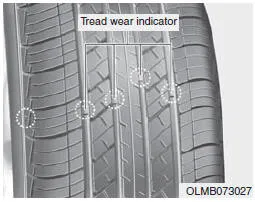
On the Hyundai Accent, a tire that wears evenly will eventually reveal the built-in tread wear indicators. These indicators appear as a solid, continuous band across the tread and confirm there is less than 2/32 inch (1.6 mm) of usable tread remaining. Replace the tire when this happens to help maintain safe braking performance, stable steering control, and reliable wet-weather traction.
Do not wait until the entire tread surface becomes level with the tread wear indicators before replacing the tire. Replacing tires early—before traction drops significantly—helps your Hyundai Accent remain predictable during emergency maneuvers and reduces the risk of hydroplaning on standing water.
WARNING
To reduce the risk of DEATH or SERIOUS INJURY:
- Replace tires that are worn, show uneven wear, or are damaged. Worn tires can cause loss of braking effectiveness, steering control, and traction.
- Always replace tires with the same size as each tire that was originally supplied with this vehicle. Using tires and wheels other than the recommended sizes could cause unusual handling characteristics, poor vehicle control, or negatively affect your vehicle's Anti-Lock Brake System (ABS) resulting in a serious accident.
- Tires degrade over time, even when they are not being used. Regardless of the remaining tread, have the tires replaced after six (6) years of normal service. Inspect older tires more frequently for sidewall cracking, bulges, or hardening, especially on a Hyundai Accent that is parked outdoors in sun or heat.
- When replacing tires (or wheels), replace the two front or two rear tires (or wheels) as a pair. Replacing just one tire can seriously affect your vehicle's handling. If only replacing one pair of tires, install the pair of new tires on the rear axle to help keep the Hyundai Accent stable during braking and cornering.
- Heat caused by hot climates or frequent high loading conditions can accelerate the aging process. Failure to follow this warning may cause sudden tire failure, which could lead to a loss of vehicle control resulting in an accident.
Compact spare tire replacement
A compact spare tire has a shorter tread life than a regular size tire. Replace it when you can see the tread wear indicator bars on the tire. The replacement compact spare tire should be the same size and design tire as the one provided with your new vehicle and should be mounted on the same compact spare tire wheel. The compact spare tire is not designed to be mounted on a regular size wheel, and the compact spare tire wheel is not designed for mounting a regular size tire. For Hyundai Accent emergency use, drive smoothly, avoid sudden lane changes, and restore a full-size tire as soon as the original tire can be repaired or replaced. Follow any speed and distance limits marked on the compact spare, and check the compact spare pressure regularly while it is in use.
WARNING
The original tire should be repaired or replaced as soon as possible to avoid failure of the spare and loss of vehicle control resulting in an accident.The compact spare tire is for emergency use only. Do not operate your vehicle over 50 mph (80 km/h) when using the compact spare tire.
Wheel Replacement
When replacing the metal wheels for any reason, make sure the new wheels are equivalent to the original factory units in diameter, rim width and offset. Matching these specifications helps protect suspension geometry, keeps the Hyundai Accent steering feel consistent, and supports correct ABS and stability operation.
Tire Traction
Tire traction can be reduced if you drive on worn tires, tires that are improperly inflated or on slippery road surfaces. Tires should be replaced when the tread depth is at least 2/32 inch (1.6 mm). To reduce the possibility of losing control, slow down whenever there is rain, snow or ice on the road, and increase following distance because stopping distances can increase quickly.
Tire Maintenance
In addition to proper inflation, correct wheel alignment helps to decrease tire wear. If you find a tire is worn unevenly, have your dealer check the wheel alignment. For best Hyundai Accent tire life, correct the cause of abnormal wear (alignment, balance, or suspension issues) before installing new tires.
When you have new tires installed, make sure they are balanced. This will increase vehicle ride comfort and tire life. Additionally, a tire should always be rebalanced if it is removed from the wheel, and lug nuts should be tightened to the specified torque to prevent vibration.
Tire Sidewall Labeling
This information identifies and describes the fundamental characteristics of the tire and also provides the tire identification number (TIN) for safety standard certification. The TIN can be used to identify the tire in case of a recall, so keeping a photo of the DOT code with your Hyundai Accent service records can be helpful.
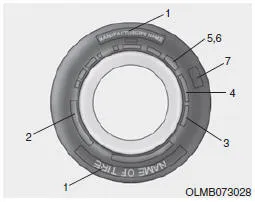
1. Manufacturer or brand name
Manufacturer or brand name is shown.
2. Tire size designation
A tire's sidewall is marked with a tire size designation. You will need this information when selecting replacement tires for your car. The following explains what the letters and numbers in the tire size designation mean and why they matter for correct Hyundai Accent fitment.
Example tire size designation:
(These numbers are provided as an example only; your tire size designator could vary depending on your vehicle.)
225/45R17 91W
225 - Tire width in millimeters.
45 - Aspect ratio. The tire's section height as a percentage of its width.
R - Tire construction code (Radial).
17 - Rim diameter in inches.
91 - Load Index, a numerical code associated with the maximum load the tire can carry.
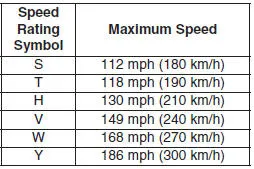
W - Speed Rating Symbol. See the speed rating chart in this section for additional information.
Wheel size designation
Wheels are also marked with important information that you need if you ever have to replace one. The following explains what the letters and numbers in the wheel size designation mean and how they relate to tire sizing.
Example wheel size designation: 7.0J X 17
7.0 - Rim width in inches.
J - Rim contour designation.
17 - Rim diameter in inches.
Tire speed ratings
The chart below lists many of the different speed ratings currently being used for passenger vehicle tires. The speed rating is part of the tire size designation on the sidewall of the tire. This symbol corresponds to that tire’s designed maximum safe operating speed, assuming proper inflation, correct load, and good tire condition.
3. Checking tire life (TIN : Tire Identification Number)
Any tires that are over six years old, based on the manufacturing date, (including the spare tire) should be replaced by new ones. You can find the manufacturing date on the tire sidewall (possibly on the inside of the wheel), displaying the DOT Code. The DOT Code is a series of numbers on a tire consisting of numbers and English letters. The manufacturing date is designated by the last four digits (characters) of the DOT code.
DOT : XXXX XXXX OOOO
The front part of the DOT shows a plant code number, tire size and tread pattern and the last four numbers indicate week and year manufactured.
For example:
DOT XXXX XXXX 1421 represents that the tire was produced in the 14th week of 2021.
4. Tire ply composition and material
The number of layers or plies of rubber-coated fabric in the tire. Tire manufacturers also must indicate the materials in the tire, which include steel, nylon, polyester, and others. The letter "R" means radial ply construction; the letter "D" means diagonal or bias ply construction; and the letter "B" means belted-bias ply construction.
5. Maximum permissible inflation pressure
This number is the greatest amount of air pressure that should be put in the tire. Do not exceed the maximum permissible inflation pressure. Refer to the Tire and Loading Information label for recommended inflation pressure.
6. Maximum load rating
This number indicates the maximum load in kilograms and pounds that can be carried by the tire. When replacing the tires on the vehicle, always use a tire that has the same load rating as the factory installed tire to keep the Hyundai Accent within its designed load capacity.
7. Uniform tire quality grading
Quality grades can be found where applicable on the tire sidewall between tread shoulder and maximum section width.
For example:
TREAD WEAR 200
TRACTION AA
TEMPERATURE A
Tread wear
The tread wear grade is a comparative rating based on the wear rate of the tire when tested under controlled conditions on a specified government test course. For example, a tire graded 150 would wear one-and-a-half times (1½) as well on the government course as a tire graded 100.
The relative performance of tires depends upon the actual conditions of their use, however, and may depart significantly from the norm due to variations in driving habits, service practices and differences in road characteristics and climate.
These grades are molded on the sidewalls of passenger vehicle tires. The tires available as standard or optional equipment on your vehicle may vary with respect to grade.
Traction - AA, A, B & C
The traction grades, from highest to lowest, are AA, A, B and C. Those grades represent the tire's ability to stop on wet pavement as measured under controlled conditions on specified government test surfaces of asphalt and concrete. A tire marked C may have poor traction performance.
WARNING
The traction grade assigned to this tire is based on straightahead braking traction tests, and does not include acceleration, cornering, hydroplaning, or peak traction characteristics.
Additional note: After installing new tires on your Hyundai Accent, check cold inflation pressures, verify valve caps are installed, and recheck lug nut torque after a short drive to support even wear and consistent handling.
Temperature - A, B & C
The temperature grades are A (the highest), B, and C, and they indicate a tire’s resistance to heat generation as well as its ability to dissipate heat when tested under controlled conditions on a specified indoor laboratory test wheel. These ratings help evaluate how well a tire used on a Hyundai Accent can manage heat during sustained driving.
Prolonged exposure to high temperatures can cause tire materials to deteriorate more rapidly, significantly reducing tire life. Excessive heat buildup may also lead to sudden tire failure. Grade C represents the minimum level of performance that all passenger vehicle tires must meet under Federal Motor Vehicle Safety Standard No. 109. Grades B and A represent progressively higher levels of performance on the laboratory test wheel than the minimum required by law, offering additional safety margins for vehicles such as the Hyundai Accent.
WARNING
The temperature grade for this tire is established for a tire that is properly inflated and not overloaded. Excessive speed, under-inflation, over-inflation, or excessive loading, either separately or in combination, can cause heat build-up and possible sudden tire failure. This may cause loss of vehicle control resulting in an accident.


Other information:
Hyundai Accent (HC) (2017 - 2022) Owner's Manual: Owner maintenance
WARNING Performing maintenance work on a vehicle can be dangerous. If you lack sufficient knowledge and experience or the proper tools and equipment to do the work, have it done by an authorized HYUNDAI dealer. ALWAYS follow these precautions for performing maintenance work: Park your vehicle on level ground, move the shift lever into the P (Park, for intelligent variable transmission vehicle) position or neutral (for manual transmission vehicle), apply the parking brake, place the ignition switch in the LOCK/OFF position.Hyundai Accent (HC) (2017 - 2022) Owner's Manual: Seat Belt Restraint System
In the Hyundai Accent, the seat belt restraint system is designed to hold occupants in the correct position during everyday driving and to help reduce injury risk in a sudden stop or collision. For the best protection, always wear your seat belt correctly and confirm every passenger is properly buckled up before the Hyundai Accent starts moving. WARNING Improperly positioned seat belts may increase the risk of serious injury in an accident.
Categories
- Manuals Home
- Hyundai Accent Owners Manual
- Hyundai Accent Service Manual
- Questions & Answers
- Video Guides
- Useful Resources
- New on site
- Most important about car
- Privacy Policy

0.0108