
Hyundai Accent (HC): Engine Electrical System / Cruise Control System
Contents:
Description and Operation
Schematic Diagrams
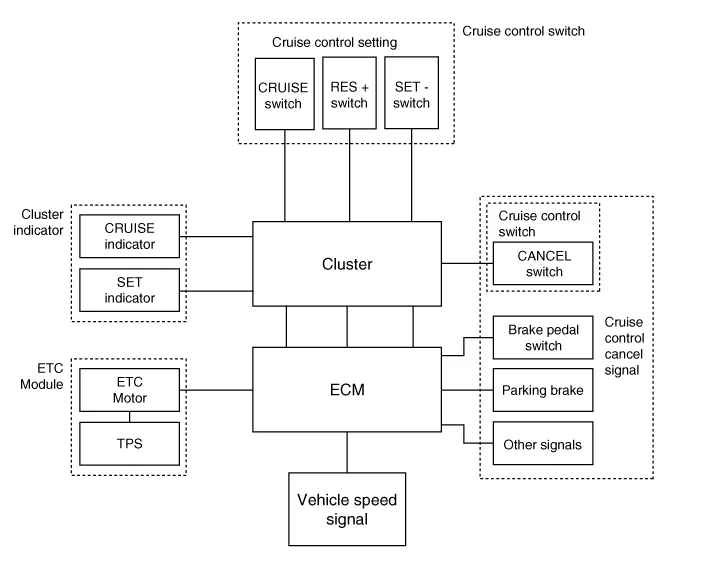
| Component part | Function | |
| Vehicle-speed sensor, ESP/ABS Control Module | Converts vehicle speed to pulse. | |
| ECM | Receives signals from sensor and control switches. | |
| Cruise control indicator | Illuminate when CRUISE main switch is ON (Built into cluster) | |
| Cruise Control switches | CRUISE switch | Switch for automatic speed control power supply. |
| RES+ switch | Controls automatic speed control functions by Resume/Accel switch (Set/Coast switch) | |
| SET- switch | ||
| Cancel switches | Cancel switch | Sends cancel signals to ECM. |
| Brake-pedal switch | ||
| Transaxle range switch (A/T) | ||
| ETC motor | Regulates the throttle valve to the set opening by ECM. | |
* ETC Motor : Electronic Throttle Control Motor
Troubleshooting
Trouble Symptom 1
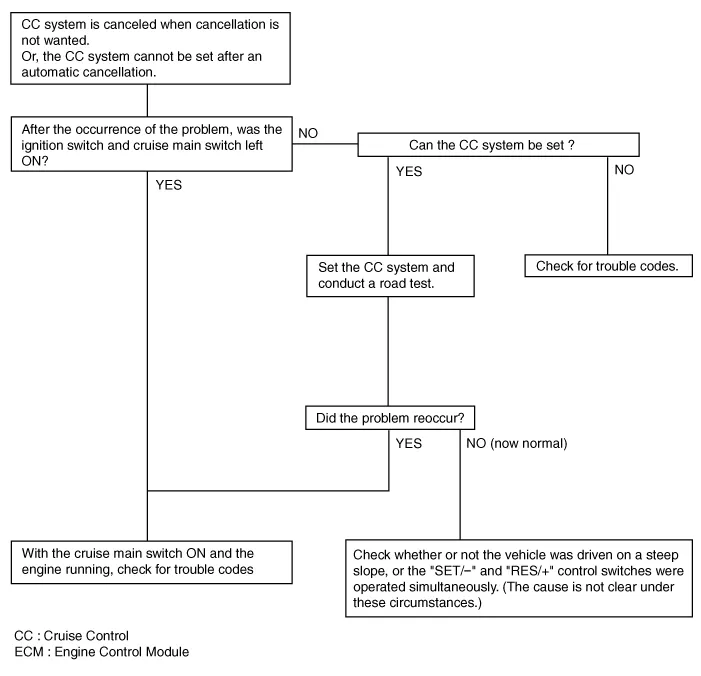
| Trouble symptom | Probable cause | Remedy |
| The set vehicle speed varies greatly upward or downward "Surging" (repeated alternating acceleration and deceleration) occurs after setting | Malfunction of the vehicle speed sensor circuit | Repair the vehicle speed sensor system, or replace the part |
| Malfunction of ECM | Check input and output signals at ECM |
| Trouble symptom | Probable cause | Remedy |
| The CC system is not canceled when the brake pedal is depressed | Damaged or disconnected wiring of the brake pedal switch | Repair the harness or replace the brake pedal switch |
| Malfunction of the ECM signals | Check input and output signals at ECM |
| Trouble symptom | Probable cause | Remedy |
| The CC system is not canceled when the shift lever is moved to the "N" position (It is canceled, however, when the brake pedal is depressed) | Damaged or disconnected wiring of inhibitor switch input circuit | Repair the harness or repair or replace the inhibitor switch |
| Improper adjustment of inhibitor switch | ||
| Malfunction of the ECM signals | Check input and output signals at ECM |
| Trouble symptom | Probable cause | Remedy |
| Cannot decelerate (coast) by using the "SET/–" switch | Temporary damaged or disconnected wiring of "SET/–" switch input circuit | Repair the harness or replace the "SET/–" switch |
| Malfunction of the ECM signals | Check input and output signals at ECM |
| Trouble symptom | Probable cause | Remedy |
| Cannot accelerate or resume speed by using the "RES/+" switch | Damaged or disconnected wiring, or short circuit, or "RES/+" switch input circuit | Repair the harness or replace the "RES/+" switch |
| Malfunction of the ECM signals | Check input and output signals at ECM |
| Trouble symptom | Probable cause | Remedy |
| CC system can be set while driving at a vehicle speed of less than 40km/h (25mph), or there is no automatic cancellation at that speed | Malfunction of the vehicle-speed sensor circuit | Repair the vehicle speed sensor system, or replace the part |
| Malfunction of the ECM signals | Check input and output signals at ECM |
| Trouble symptom | Probable cause | Remedy |
| The cruise main switch indicator lamp does not illuminate (although CC system is normal) | Damaged or disconnected bulb of cruise main switch indicator lamp | Repair the harness or replace the part. |
| Harness damaged or disconnected |
Cruise Control Switch
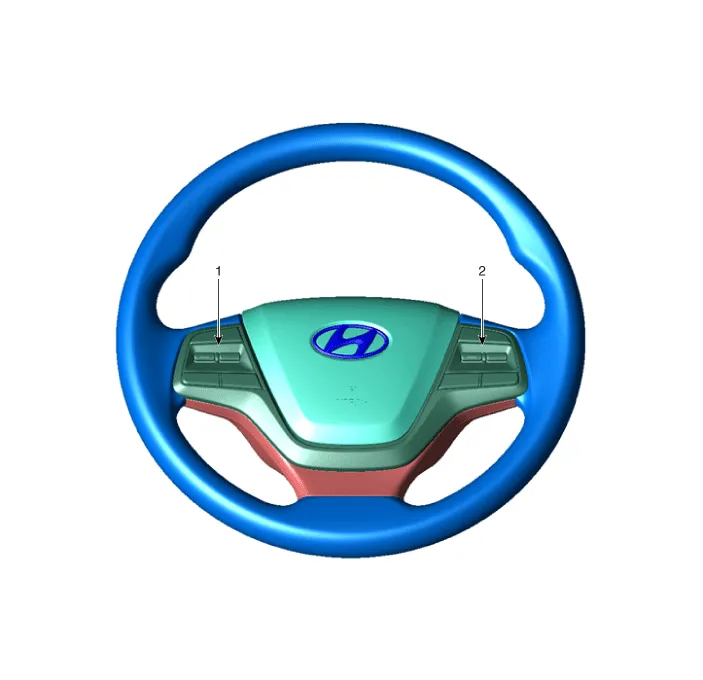
1. Remote control switch (LH)
2. Remote control switch (RH)
1.Turn the ignition switch OFF and disconnect the battery negative (-) cable.
2.Remove the steering wheel assembly.
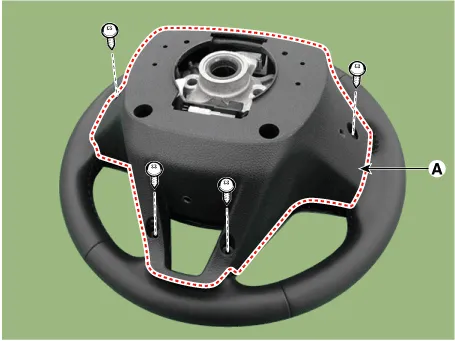
3.Remove the screws from the steering back cover (A).
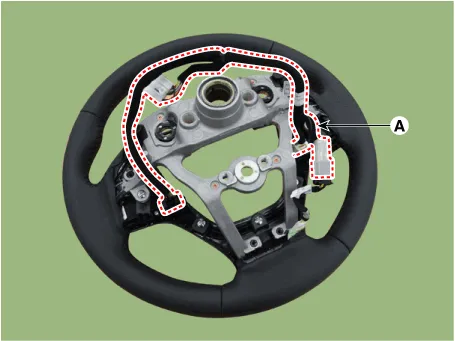
4. Remove the steering remote control connector (A).
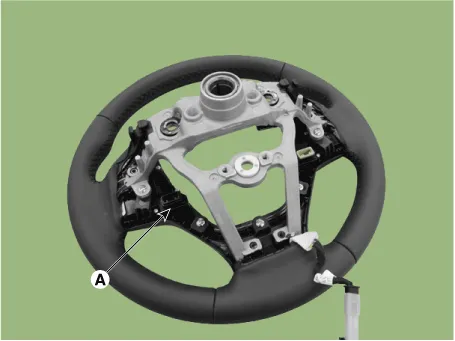
5.Remove the steering remote control (A) after loosening the screws.
1. Install in the reverse order of removal.
1.Install the steering wheel remote controll and cover after connecting the connector.
2. Install the steering wheel and driver airbag module.
3.Connect the negative (-) battery terminal.
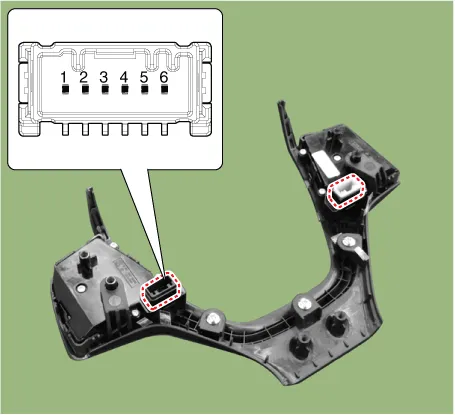
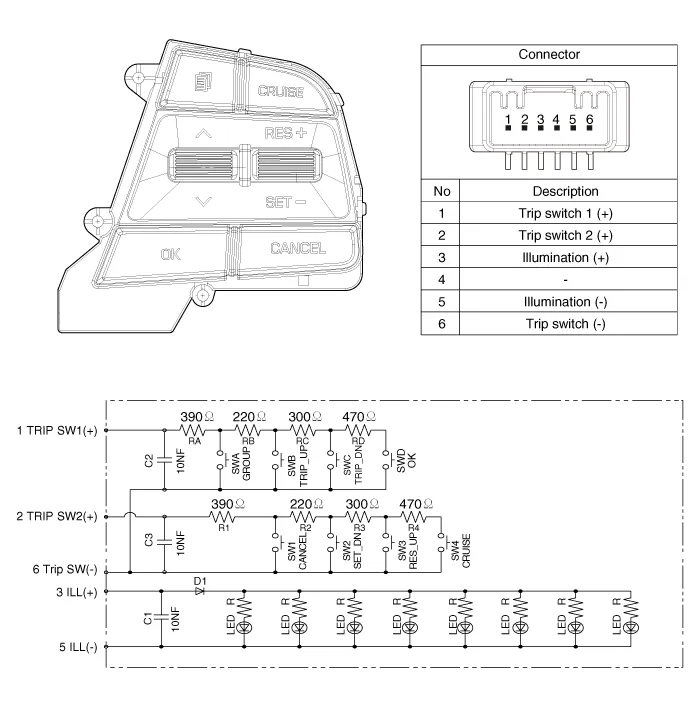
4.Measure the resistance between terminals on the control switch when each function switch is ON (and switch is depressed).
| Switch | Connector terminal | Resistance (± 5%) |
| CANCEL | 2 - 5 | 390 Ω |
| SET (-) | 2 - 5 | 610 Ω |
| RES (+) | 2 - 5 | 910 Ω |
| CRUISE | 2 - 5 | 1.38 kΩ |


Other information:
Hyundai Accent (HC) (2017 - 2022) Service Manual: General Service Information
- General Service Information Protection of the VehicleAlways be sure to cover fenders, seats, and floor areas prior to beginning work. • The support rod must be inserted into the hole near the edge of the hood whenever you inspect the engine compartment to prevent the hood from falling and causing possible injury. • Make sure that the support rod has been released prior to closing the hood.Hyundai Accent (HC) (2017 - 2022) Service Manual: Air bag - Advanced supplemental restraint system
In addition to seat belts and child restraints, the Hyundai Accent uses an Advanced Supplemental Air Bag System to help protect occupants in certain types of crashes. Air bags are not a substitute for seat belts; they are designed to work with properly worn belts. 1. Driver's front air bag 2. Passenger's front air bag 3. Side air bag 4. Curtain air bag This vehicle is equipped with an Advanced Supplemental Air Bag System for the driver's seat and front passenger's seats.
Contents
Categories
- Manuals Home
- Hyundai Accent Owners Manual
- Hyundai Accent Service Manual
- Questions & Answers
- Video Guides
- Useful Resources
- New on site
- Most important about car
- Privacy Policy

0.0116