
Hyundai Accent (HC): Advanced Driver Assistance System (ADAS) / Parking Distance Warning (PDW)
Contents:
- Specifications
- Components and Components Location
- Description and Operation
- Parking Distance Warning (PDW) Sensor
Specifications
| Item | Specification | |
| Ultrasonic sensor | Voltage rating | DC 12 V |
| Detecting range | 30 cm - 120 cm | |
| Operation voltage | DC 9 - 16 V | |
| Operation current | MAX 350 mA | |
| Operation temperature | -30°C to +80°C | |
| Operation frequency | 48 ± 5 KHz | |
| Number of sensors | 4 (Left side, Left center, Right center, Right side) | |
Parking distance warning (PDW) control unit function is built in BCM (Body control unit).
Components and Components Location
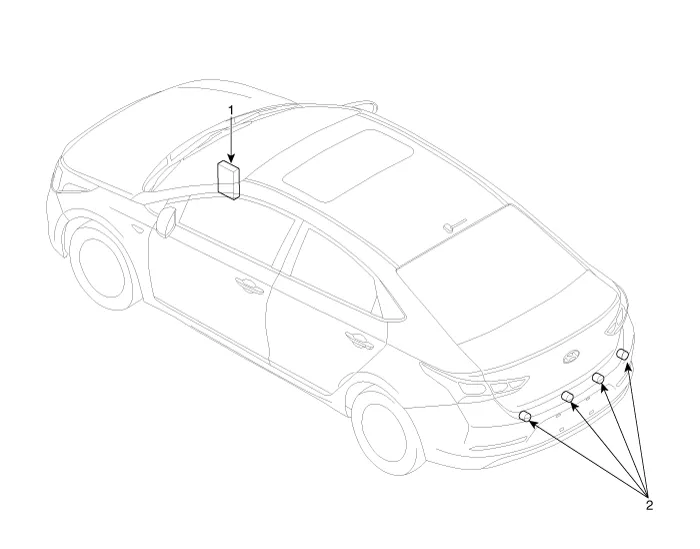
1. Body control unit (BCM)
2. Parking distance warning sensor
Description and Operation
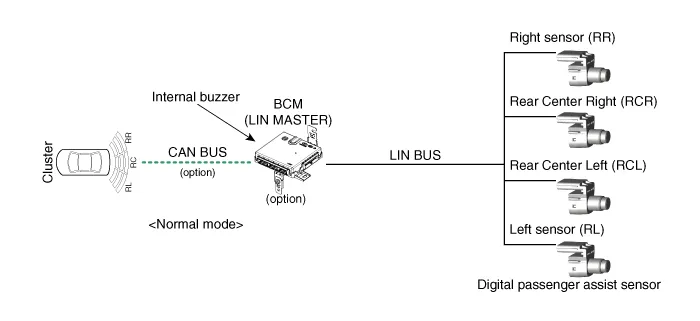
• PDW consists of 8 sensors (front : 4 units, rear : 4 units) that are used to detect obstacles and transmit the result in three separate warning levels, the first, second and third to IBU via LIN communication.
• IBU decides the alarm level by the transmitted communication message from the slave sensors, then operates the buzzer or transmits the data for display.
Initial mode
1.System initializing time
– PDW-R : 500ms after IGN1+ initial R Gear
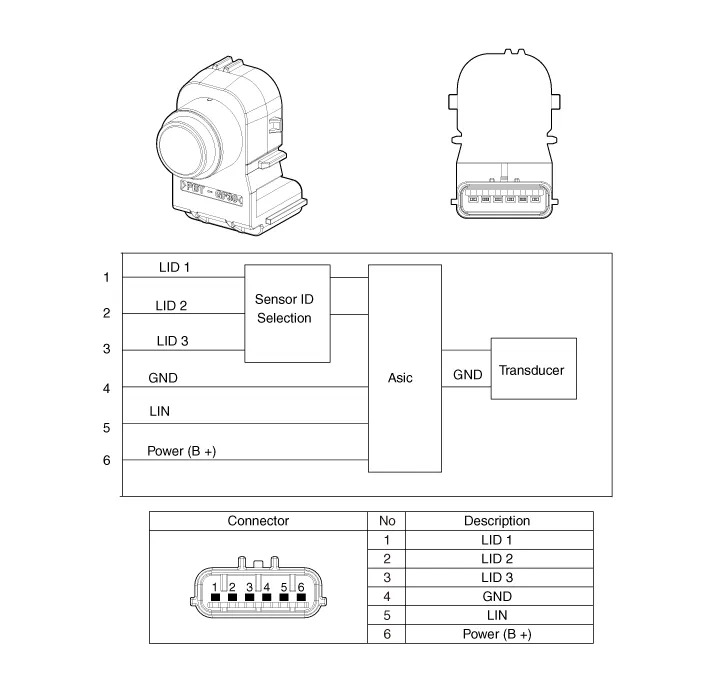
2.PDW recognizes LID and sets the sensor ID up during initialization.
3.PDW activates each sensor and then executes the diagnosis after finishing initialization of BCM.
4.PDW starting buzzer is normally worked, when sensor does not send an error message and after finishing error diagnosis.
5.If any failure is received from the any sensors, PDW starting buzzer does not work but the failure alarm is operated for a moment.If you have display option, warning sign is also shown on it.

6.IBU memorizes the completed initializing status of sensor.
Normal mode
1.PDW-F : Lin communication starts and keeps the routine after IGN1 ON+D gear + below 10 km/h. PDW-R : Lin communication starts and keeps the routine after IGN1 ON+R gear
2.After initializing, the routine starts at once without PDW starting warning sound.
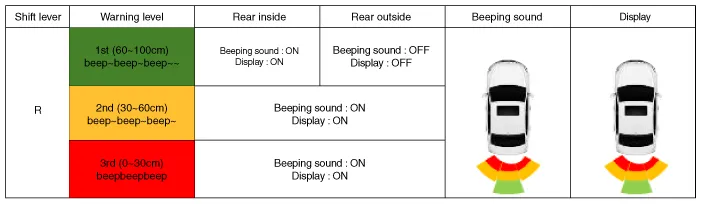
3.Alarms of obstacle consists of 3 level 1,2,3 step and 1,2 alarm sounds intermittently and 3 alarm sounds continuously. 1 level alarm doesn't exist in the front ultrasonic sensor.
4.In display, the data of each sensor is sent from IBU to display, for example cluster. CAN communication is used for transmission and maximum gateway time is 50ms.
5.The efficient vehicle speed of PDW operation is under 10Km/h.
6.Operation doesn't start or stops at gear N, P.
| Level | Distance range | Allowed range |
| 1 | Rear : 61 - 120 cm (24.02 - 47.2 in.) | ± 15 cm (5.90 in.) |
| 2 | 31 - 60 cm (12.20 - 23.62 in.) | ± 15 cm (5.90 in.) |
| 3 | 0 - 30 cm (0 - 11.81 in) | ± 10 cm (3.94 in.) |
*Measurement condition : PVC pipe - Diameter 75 mm (0.0394 in.), length 1 m (39.37 in.), at normal temperature
Parking Distance Warning (PDW) Sensor
1.Remove the bumper cover.(Refer to Body - "Front Bumper Cover")(Refer to Body - "Rear Bumper Cover")
2.Disconnect the connector (A) from the PDW sensor (B).
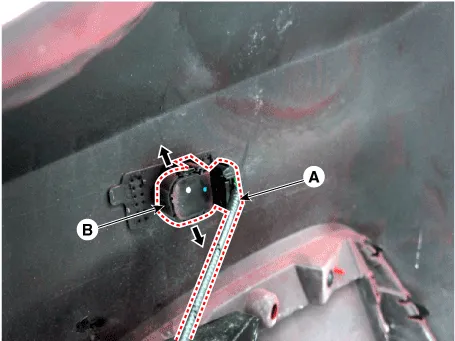
1.Install the PDW sensor.
2.Install the bumper cover.


Other information:
Hyundai Accent (HC) (2017 - 2022) Service Manual: Starter
- Specification Starter ItemSpecification Rated voltage12V, 0.9 kW The number of pinion teeth10 Performance[No-load, 11.5V]Ampere83.6 A Speed3,500 rpm - Components 1. Screw2. Front bracket3. Reducer assembly4. Lever5. Lever rest6. Magnet switch 7. Satellite gear8. Gasket sheet9. Armature assembly10. Yoke assembly11. Adjust washer12.Hyundai Accent (HC) (2017 - 2022) Service Manual: General Safety Information and Caution
- Instructions • The R-1234yf liquid refrigerant is flammable gas. The gas reduces oxygen available for breathing and causes asphyxiation in high concentrations. The victim will not realize that he/she is suffocating. • Inhalation may cause central nervous system effects and may cause drowsiness and dizziness. • Ingestion may cause gastrointestinal discomfort.
Contents
- Specifications
- Components and Components Location
- Description and Operation
- Parking Distance Warning (PDW) Sensor
Categories
- Manuals Home
- Hyundai Accent Owners Manual
- Hyundai Accent Service Manual
- Questions & Answers
- Video Guides
- Useful Resources
- New on site
- Most important about car
- Privacy Policy

0.0102