
Hyundai Accent (HC): Safety System of Your Vehicle / Seats
Contents:
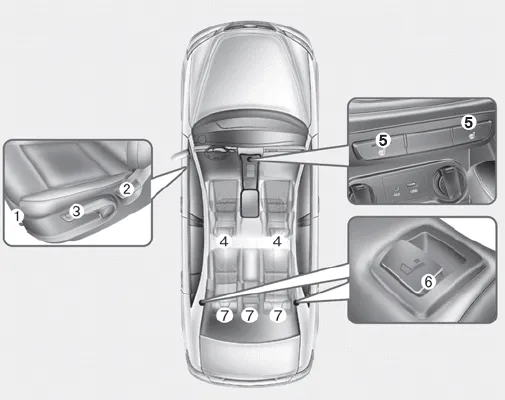
Front seat
1. Forward and backward — adjust distance to pedals and steering wheel for safe control
2. Seatback angle — set a comfortable upright angle that supports your back
3. Seat height (Driver's seat) — adjust eye level for clear visibility over the hood
4. Headrest — align with the head for whiplash protection in a collision
5. Seat warmer — comfort feature for cold weather driving (if equipped)
Rear seat
6. Seatback folding — expand cargo flexibility when needed
7. Headrest — supports rear occupants and helps reduce injury risk
Safety Precautions
Adjusting the seats so that you are sitting in a safe, comfortable position plays an important role in driver and passenger safety together with the seat belts and air bags in an accident. In the Hyundai Accent, take time before driving to set seat distance, height, and seatback angle so you can reach controls easily without leaning forward.
WARNING
Do not use a cushion that reduces friction between the seat and the passenger. The passenger's hips may slide under the lap portion of the seat belt during an accident or a sudden stop. Serious or fatal internal injuries could result because the seat belt cannot operate properly.
Air bags
You can take steps to reduce the risk of being injured by an inflating air bag. Sitting too close to an air bag greatly increases the risk of injury in the event the air bag inflates. For the best protection in the Hyundai Accent, sit back with your shoulders against the seatback and keep a safe distance from the steering wheel and dashboard.
The National Highway Traffic Safety Administration (NHTSA) recommends that drivers allow at least 10 inches (25 cm) between the center of the steering wheel and their chest. Use this guideline when setting your driving position in the Hyundai Accent, while still ensuring full control of steering and pedals.
WARNING
To reduce the risk of serious injury or death from an inflating air bag, take the following precautions:
- Adjust the driver's seat as far to the rear as possible while maintaining the ability to maintain full control of the vehicle.
- Adjust the front passenger seat as far to the rear as possible.
- Hold the steering wheel by the rim with hands at the 9 o'clock and 3 o'clock positions to minimize the risk of injuries to your hands and arms.
- NEVER place anything or anyone between the steering wheel and the air bag.
- Do not allow the front passenger to place feet or legs on the dashboard to minimize the risk WARNING of leg injuries.
Seat belts
Always fasten your seat belt before driving the vehicle. Make it a habit in your Hyundai Accent to check that all occupants are buckled up before you shift into gear.
At all times, passengers should sit upright and be properly restrained. Infants and small children must be restrained in appropriate child restraint systems. Adults and children who have outgrown a booster seat must be restrained using the seat belts. Never compromise on restraints, even for short trips in the Hyundai Accent.
WARNING
Take the following precautions when adjusting your seat belt:
- NEVER use one seat belt for more than one occupant.
- Always position the seatback upright with the lap portion of the seat belt snug and low across the hips.
- NEVER allow children or small infants to ride on a passenger's lap.
- Do not route the seat belt across your neck, across sharp edges, or reroute the shoulder strap away from your body.
- Do not allow the seat belt to become caught or jammed.
Front Seats
For everyday comfort and long-term safety in your Hyundai Accent, take a moment to set your seating position correctly before you start driving. A properly adjusted seat helps you reach the steering wheel, pedals, and controls naturally, while also allowing the seat belts and air bags in the Hyundai Accent to work as intended.
WARNING
Take the following precautions when adjusting your seat:
- NEVER attempt to adjust the seat while the vehicle is moving. The seat could respond with unexpected movement and may cause loss of vehicle control resulting in an accident. Always adjust the Hyundai Accent seat when parked in a safe location.
- Do not place anything under the front seats. Loose objects in the driver's foot area could interfere with the operation of the foot pedals, causing an accident. Keep the Hyundai Accent floor area clear so the pedals can move freely.
- Do not allow anything to interfere with the normal position and proper locking of the seatback. An unlocked seatback may shift suddenly during braking or a collision.
- Do not place a cigarette lighter on the floor or seat. When you operate the seat, gas may exit out of the lighter causing a fire. Store lighters and similar items in a safe compartment.
- Use extreme caution when picking up small objects trapped under the seats or between the seat and the center console. Your hands might be cut or injured by the sharp edges of the seat mechanism. If needed, stop the Hyundai Accent, turn it off, and use a flashlight to retrieve items carefully.
CAUTION
To prevent injury:
- Do not adjust your seat while wearing your seat belt. Moving the seat cushion forward may cause strong pressure on your abdomen and may reduce proper belt positioning.
- Do not allow your hands or fingers to get caught in the seat mechanisms while the seat is moving. Keep hands clear of levers, rails, and hinges.
Manual adjustment
The front seat can be adjusted by using the levers located on the outside of the seat cushion. Before driving the Hyundai Accent, adjust the seat to a proper position so that you can easily control the steering wheel, foot pedals, and controls on the instrument panel. A good driving position also improves visibility and helps reduce fatigue on longer trips.
Forward and rearward adjustment
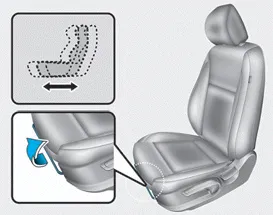
To move the seat forward or rearward:
1. Pull up the seat slide adjustment lever and hold it.
2. Slide the seat to the position you desire. In the Hyundai Accent, choose a distance that allows full pedal travel without stretching and keeps your back supported by the seatback.
3. Release the lever and make sure the seat is locked in place. Move forward and rearward without using the lever. If the seat moves, it is not locked properly and must be secured before driving.
Seatback angle
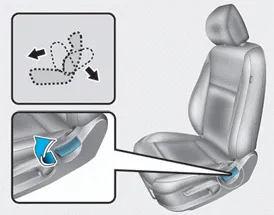
To recline the seatback:
1. Lean forward slightly and lift up the seatback lever.
2. Carefully lean back on the seat and adjust the seatback to the position you desire. For best protection in the Hyundai Accent, keep the seatback as upright as comfort allows.
3. Release the lever and make sure the seatback is locked in place. (The lever MUST return to its original position for the seatback to lock.)
Reclining seatback
Sitting in a reclined position when the vehicle is in motion can be dangerous. Even when buckled up, the protection of your restraint system (seat belts and air bags) is greatly reduced by reclining your seatback. In a Hyundai Accent, the seat belt is designed to fit snugly across your body when you are seated upright.
WARNING
NEVER ride with a reclined seatback when the vehicle is moving.
Riding with a reclined seatback increases your chance of serious or fatal injuries in the event of a collision or sudden stop.
Drivers and passengers should ALWAYS sit well back in their seats, properly belted, and with the seatbacks upright.
Seat belts must be snug against your hips and chest to work properly. When the seatback is reclined, the shoulder belt cannot do its job because it will not be snug against your chest. Instead, it will be in front of you. During an accident, you could be thrown into the seat belt, causing neck or other injuries. For safe Hyundai Accent driving, check that the lap belt is low and tight across the hips and the shoulder belt crosses the center of the chest.
The more the seatback is reclined, the greater chance the passenger's hips will slide under the lap belt or the passenger's neck will strike the shoulder belt. Keeping an upright seating position helps the restraint system manage crash forces more effectively.
Seat height (For driver's side)
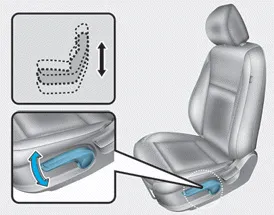
To change the height of the seat cushion:
- Push down on the lever several times, to lower the seat cushion. Set the Hyundai Accent seat height so you can see clearly over the hood and maintain comfortable leg room.
- Pull up on the lever several times, to raise the seat cushion. Make sure your head has adequate clearance and your view of the instrument cluster remains unobstructed.
Seatback pocket
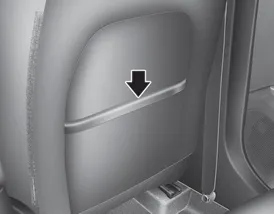
The seatback pocket is provided on the back of the front passenger's seatback. Use it for light, soft items such as maps or small documents, and avoid overloading it to help keep the Hyundai Accent cabin tidy and safe.
WARNING
To prevent the Occupant Classification System from malfunctioning:
Do not hang onto the front passenger's seatback.
CAUTION
Do not put heavy or sharp objects in the seatback pockets. In an accident they could come loose from the pocket and injure occupants. Store heavier items in the trunk or secure them properly in your Hyundai Accent.
Rear Seats
Folding the rear seat
The rear seatbacks can be folded to facilitate carrying long items or to increase the luggage capacity of the vehicle. When you use this feature in the Hyundai Accent, always plan your load so that the driver’s rear visibility and the stability of cargo are not compromised.
WARNING
- Never allow passengers to sit on top of the folded down seatback while the vehicle is moving. This is not a proper seating position and no seat belts are available for use. This could result in serious injury or death in case of an accident or sudden stop.
- Objects carried on the folded down seatback should not extend higher than the top of the front seatbacks. This could allow cargo to slide forward and cause injury or damage during sudden stops. Always secure cargo inside the Hyundai Accent using appropriate tie-down methods when available.
To fold down the rear seatback:
1. Set the front seatback to the upright position and if necessary, slide the front seat forward. This creates clearance so the rear seatback can fold smoothly in the Hyundai Accent.
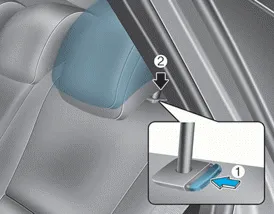
2. Lower the rear head restraints to the lowest position by pushing and holding the release button (1) and pushing down on the headrest (2).
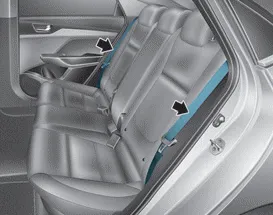
3. Move the seatbelt toward the outboard position before folding down the seatback to avoid the seatbelt system interfering with the seatback.
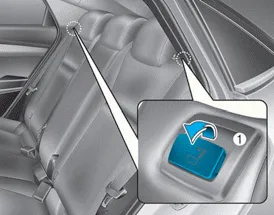
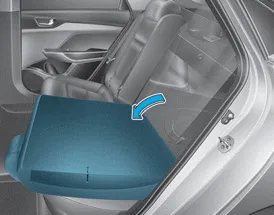
4. Pull up the seatback folding lever (1), then fold the seat toward the front of the vehicle. Fold the seatback carefully to avoid pinching the seat belt or damaging trim.
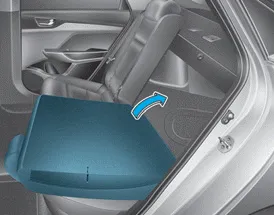
5. To use the rear seat, lift and unfold the seatback to the upright position. Push the seatback firmly until it clicks into place. Make sure the seatback is locked in place before driving the Hyundai Accent.
WARNING
When returning the rear seatback from a folded to an upright position, hold the seatback and return it slowly. Ensure that the seatback is completely locked into its upright position by pushing on the top of the seatback. In an accident or sudden stop, the unlocked seatback could allow cargo to move forward with great force and enter the passenger compartment, which could result in serious injury or death.
WARNING
Do not place objects in the rear seats, since they cannot be properly secured and may hit vehicle occupants in a collision causing serious injury or death.
WARNING
Make sure the vehicle is off, the shift lever is in P (Park), and the parking brake is securely applied whenever loading or unloading cargo. Failure to take these steps may allow the vehicle to move if the shift lever is inadvertently moved to another position.
CAUTION
- Be careful when loading cargo through the rear passenger seats to prevent damage to the vehicle interior.
- When cargo is loaded through the rear passenger seats, ensure the cargo is properly secured to prevent it from moving while driving.
- Unsecured cargo in the passenger compartment can cause damage to the vehicle or injury to it's occupants. For safer Hyundai Accent travel, keep heavy items low and restrained.
Head Restraints ➤


Other information:
Hyundai Accent (HC) (2017 - 2022) Owner's Manual: Feature of Your Audio
Head unit ■Type C ■Type D � The actual image in the Hyundai Accent may differ from the illustration. (1) POWER/VOL knob Turn to adjust the volume. Press to turn the device on or off. (2) RADIO Start FM, AM and SiriusXM* Radio. (3) MEDIA Select USB (iPod®), Bluetooth® Wireless Technology (BT) Audio, AUX or My Music. Display the media menu when two or more media are connected or when the [MEDIA] button is pressed in media mode.Hyundai Accent (HC) (2017 - 2022) Owner's Manual: CVVT & Camshaft
- Description Continuous Variable Valve Timing (CVVT) system advances or retards the valve timing of the intake and exhaust valve in accordance with the ECM control signal which is calculated by the engine speed and load.By controlling CVVT, the valve over-lap or under-lap occurs, which makes better fuel economy and reduces exhaust gases (NOx, HC) and improves engine performance through reduction of pumping loss, internal EGR effect, improvement of combustion stability, improvement of volumetric efficiency, and increase of expansion work.
Contents
Categories
- Manuals Home
- Hyundai Accent Owners Manual
- Hyundai Accent Service Manual
- Questions & Answers
- Video Guides
- Useful Resources
- New on site
- Most important about car
- Privacy Policy

0.0113