
Hyundai Accent (HC): Emission Control System
Contents:
- Specifications
- Description and Operation
- Troubleshooting
- Schematic Diagrams
- Components and Components Location
- Evaporative Emission Control System
- Exhaust Emission Control System
Specifications
| Item | Specification |
| Coil Resistance (Ω) | 12.5 ~ 16.5 [20°C (68°F)] |
| Item | kgf.m | N.m | lb-ft |
| Positive Crankcase Ventilation (PCV) valve | 1.0 - 1.2 | 9.8 - 11.7 | 2.2 - 2.6 |
| Canister mounting bolt | 2.2 - 2.4 | 21.5 - 23.5 | 4.8 - 5.2 |
| Exhaust manifold hit protecter mounting bolt | 1.0 - 1.2 | 9.8 - 11.7 | 2.2 - 2.6 |
| EGR cooler pipe mounting bolt | 1.9 - 2.4 | 18.6 - 23.5 | 4.1 - 5.2 |
| Exhaust manifold & Catalytic Converter stay mounting bolt | 4.0 - 5.0 | 39.2 - 49.0 | 8.8 - 11.0 |
| Engine mounting support braket mounting nut | 9.0 - 11.0 | 88.2 - 107.8 | 19.8 - 24.2 |
| Engine mounting support braket mounting bolt / nut | 6.0 - 7.5 | 58.8 - 73.5 | 13.2 - 16.5 |
| Exhaust manifold & Catalytic Converter mounting nut | 3.0 - 4.0 | 29.4 - 39.2 | 6.6 - 8.8 |
| Catalytic Converter & Center muffler mounting nut | 4.0 - 6.0 | 39.2 - 58.8 | 8.8 - 13.2 |
Description and Operation
• The Crankcase Emission Control System prevents blow-by gas from releasing into the atmosphere. This system recycles gas back into the intake manifold (Closed Crankcase Ventilation Type).
• The Evaporative Emission Control System prevents evaporative gas from releasing into the atmosphere. This system burns gas at appropriate engine operating condition after gathering it in the canister.
• The Exhaust Emission Control System converts the three pollutants [hydrocarbons (HC), carbon monoxide (CO), and oxides of nitrogen (NOx)] into harmless substances by using the 3-way catalytic converter.
Troubleshooting
| Symptom | Suspect area |
| Engine will not start or struggle to start | Vapor hose damaged or disconnected |
| Engine struggles to start | Malfunction of the Purge Control Solenoid Valve |
| Rough idle or engine stalls | Vapor hose damaged or disconnected |
| Malfunction of the PCV valve | |
| Rough idle | Malfunction of the Evaporative Emission Control System |
Schematic Diagrams
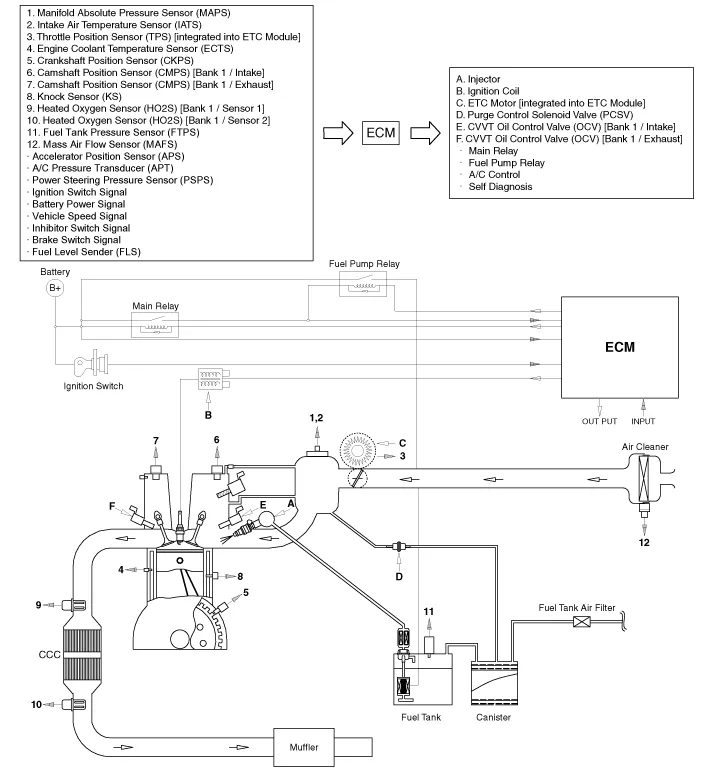
Components and Components Location
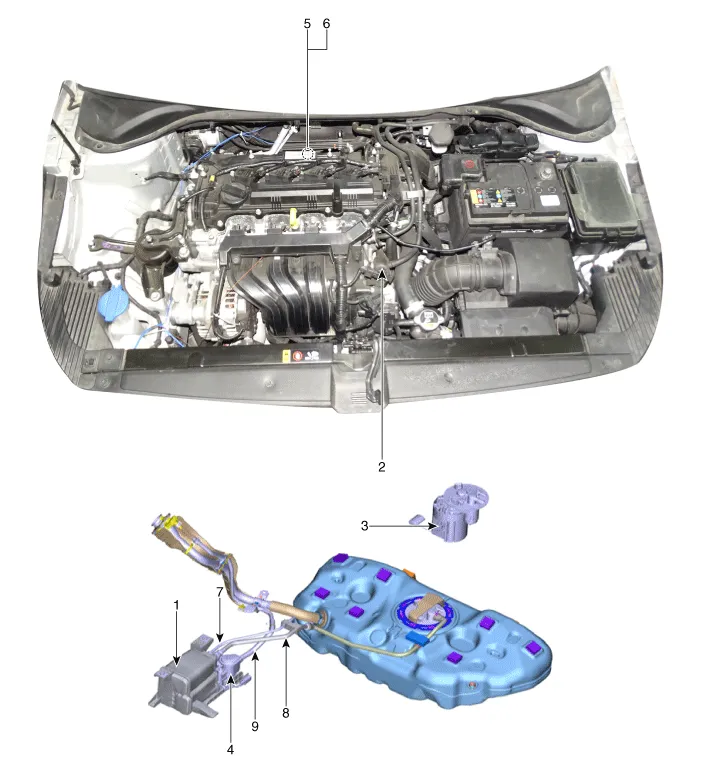
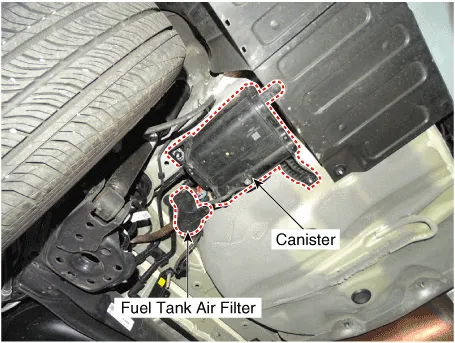
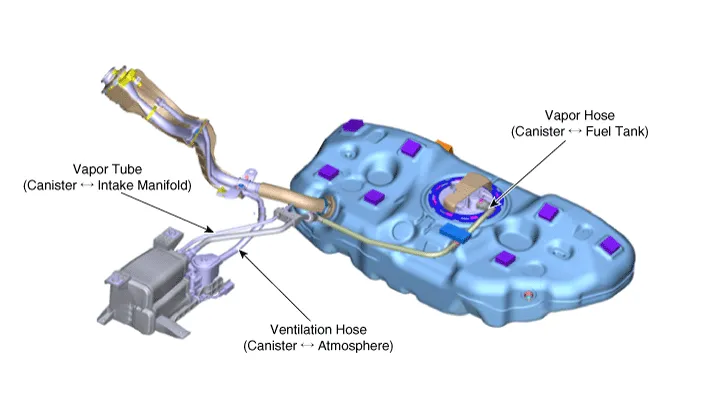
1. Canister
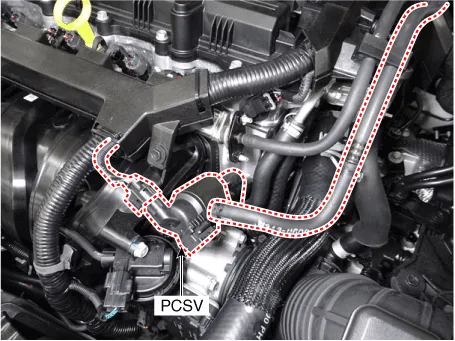
2. Purge Control Solenoid Valve (PCSV)
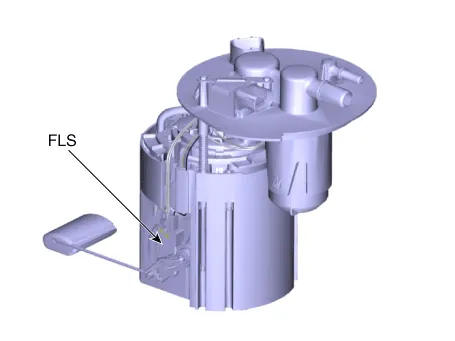
3. Fuel Level Sensor (FLS)
4. Fuel Tank Air Filter
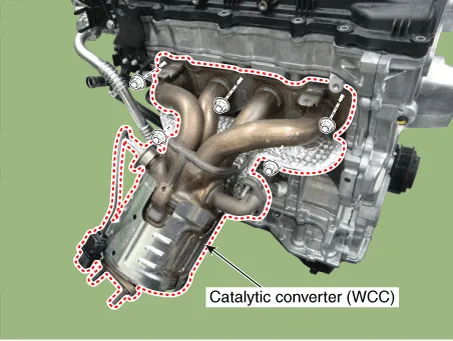
5. Catalytic converter (WCC)
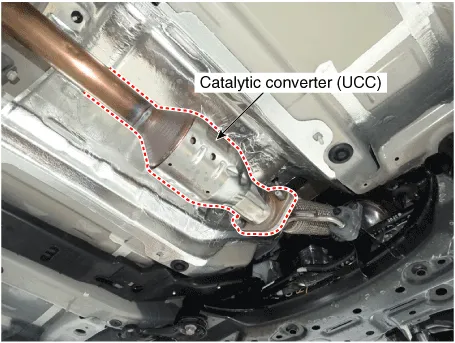
6. Catalytic converter (UCC)
7. Vapor Tube (Canister ↔ Intake Manifold)
8. Vapor Hose (Canister ↔ Fuel Tank)
9. Ventilation Hose (Canister ↔ Atmosphere)
| 1. Canister 4. Fuel Tank Air Filter | 2. Purge Control Solenoid Valve (PCSV) |
|
|
| 3. Fuel Level Sensor (FLS) | 5. Catalytic converter (WCC) |
|
|
| 6. Catalytic converter (UCC) | |
| |
| 7. Vapor Tube (Canister ↔ Intake Manifold) 8. Vapor Hose (Canister ↔ Fuel Tank) 9. Ventilation Hose (Canister ↔ Atmosphere) | |
| |
Evaporative Emission Control System ➤
Exhaust Emission Control System ➤


Other information:
Hyundai Accent (HC) (2017 - 2022) Service Manual: Repair procedures
- Diagnosis with Diagnostic tool 1.In the body electrical system, failure can be quickly diagnosed by using the vehicle diagnostic system (Diagnostic tool).The diagnostic system (Diagnostic tool) provides the following information.(1)Fault Code Searching : Checking failure and code number (DTC) (2)Data Analysis : Checking the system input/output data state (3)Actuation test : Checking the system operation condition (4)S/W Management : Controlling other features including system option setting and zero point adjustment Data Analysis 1.Hyundai Accent (HC) (2017 - 2022) Service Manual: Description and Operation
- Description of ESP Optimum driving safety now has a name : ESP, the Electronic Stability Program.ESP recognizes critical driving conditions, such as panic reactions in dangerous situations, and stabilizes the vehicle by wheel-individual braking and engine control intervention with no needfor actuating the brake or the gas pedal.ESP adds a further function known as Active Yaw Control (AYC) to the ABS, TCS, EBD and ESP functions.
Contents
- Specifications
- Description and Operation
- Troubleshooting
- Schematic Diagrams
- Components and Components Location
- Evaporative Emission Control System
- Exhaust Emission Control System
Categories
- Manuals Home
- Hyundai Accent Owners Manual
- Hyundai Accent Service Manual
- Questions & Answers
- Video Guides
- Useful Resources
- New on site
- Most important about car
- Privacy Policy

0.006