
Hyundai Accent (HC): Emission Control System
Contents:
- Specifications
- Description and Operation
- Troubleshooting
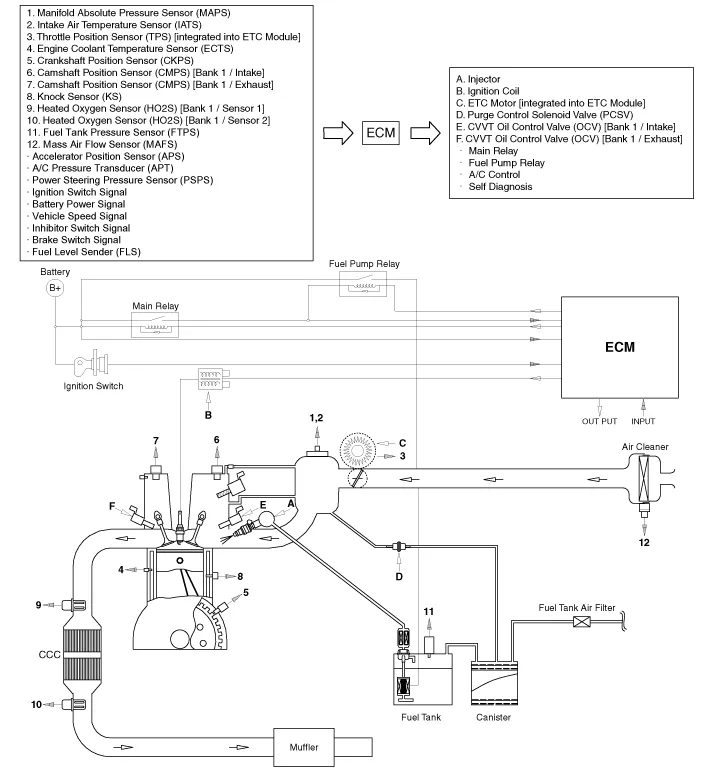
- Schematic Diagrams
- Components and Components Location
- Evaporative Emission Control System
- Exhaust Emission Control System
Specifications
| Item | Specification |
| Coil Resistance (Ω) | 12.5 ~ 16.5 [20°C (68°F)] |
| Item | kgf.m | N.m | lb-ft |
| Positive Crankcase Ventilation (PCV) valve | 1.0 - 1.2 | 9.8 - 11.7 | 2.2 - 2.6 |
| Canister mounting bolt | 2.2 - 2.4 | 21.5 - 23.5 | 4.8 - 5.2 |
| Exhaust manifold hit protecter mounting bolt | 1.0 - 1.2 | 9.8 - 11.7 | 2.2 - 2.6 |
| EGR cooler pipe mounting bolt | 1.9 - 2.4 | 18.6 - 23.5 | 4.1 - 5.2 |
| Exhaust manifold & Catalytic Converter stay mounting bolt | 4.0 - 5.0 | 39.2 - 49.0 | 8.8 - 11.0 |
| Engine mounting support braket mounting nut | 9.0 - 11.0 | 88.2 - 107.8 | 19.8 - 24.2 |
| Engine mounting support braket mounting bolt / nut | 6.0 - 7.5 | 58.8 - 73.5 | 13.2 - 16.5 |
| Exhaust manifold & Catalytic Converter mounting nut | 3.0 - 4.0 | 29.4 - 39.2 | 6.6 - 8.8 |
| Catalytic Converter & Center muffler mounting nut | 4.0 - 6.0 | 39.2 - 58.8 | 8.8 - 13.2 |
Description and Operation
• The Crankcase Emission Control System prevents blow-by gas from releasing into the atmosphere. This system recycles gas back into the intake manifold (Closed Crankcase Ventilation Type).
• The Evaporative Emission Control System prevents evaporative gas from releasing into the atmosphere. This system burns gas at appropriate engine operating condition after gathering it in the canister.
• The Exhaust Emission Control System converts the three pollutants [hydrocarbons (HC), carbon monoxide (CO), and oxides of nitrogen (NOx)] into harmless substances by using the 3-way catalytic converter.
Troubleshooting
| Symptom | Suspect area |
| Engine will not start or struggle to start | Vapor hose damaged or disconnected |
| Engine struggles to start | Malfunction of the Purge Control Solenoid Valve |
| Rough idle or engine stalls | Vapor hose damaged or disconnected |
| Malfunction of the PCV valve | |
| Rough idle | Malfunction of the Evaporative Emission Control System |
Schematic Diagrams
Components and Components Location
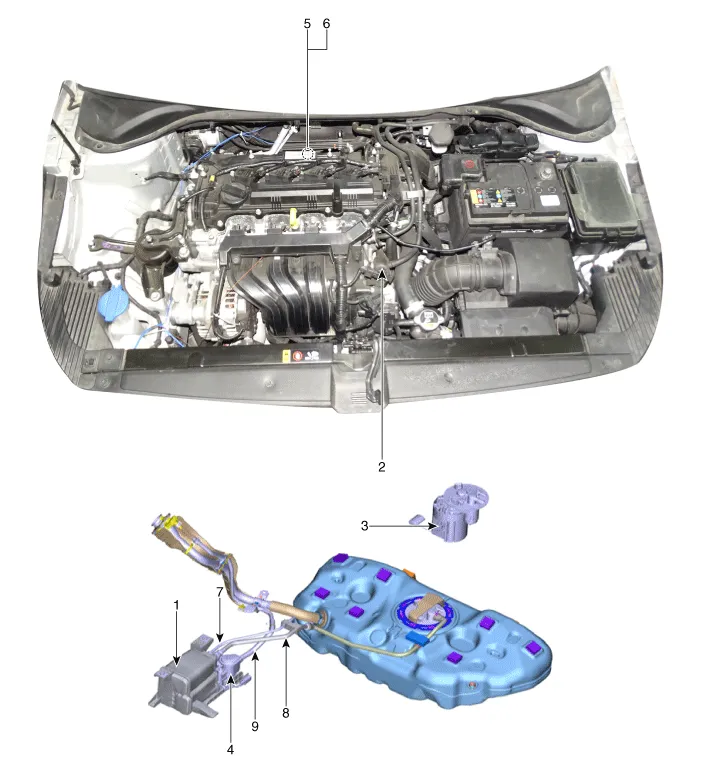
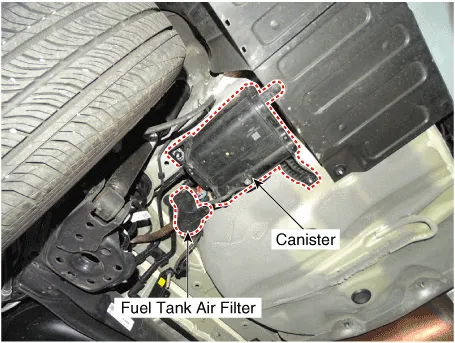
1. Canister
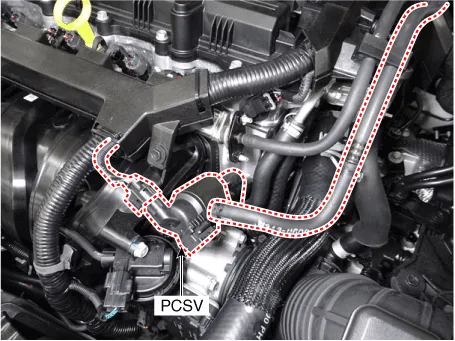
2. Purge Control Solenoid Valve (PCSV)
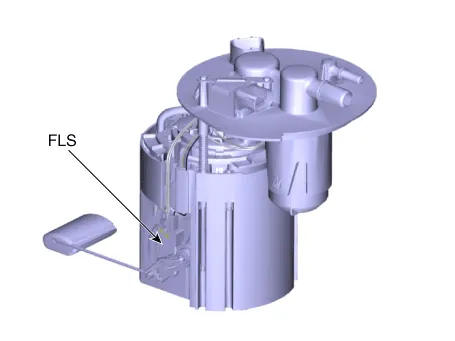
3. Fuel Level Sensor (FLS)
4. Fuel Tank Air Filter
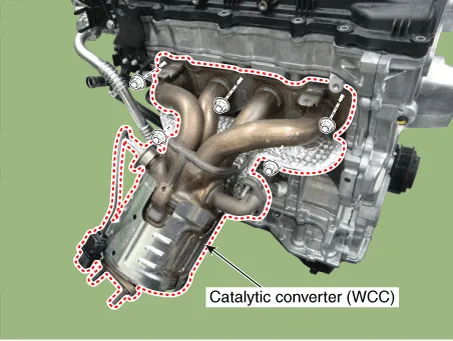
5. Catalytic converter (WCC)
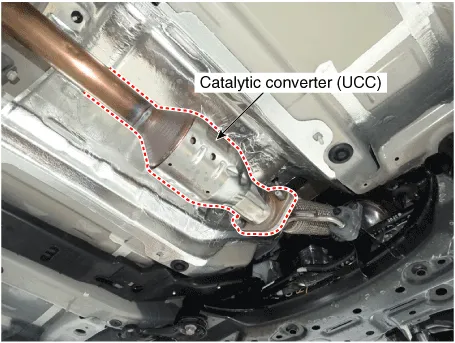
6. Catalytic converter (UCC)
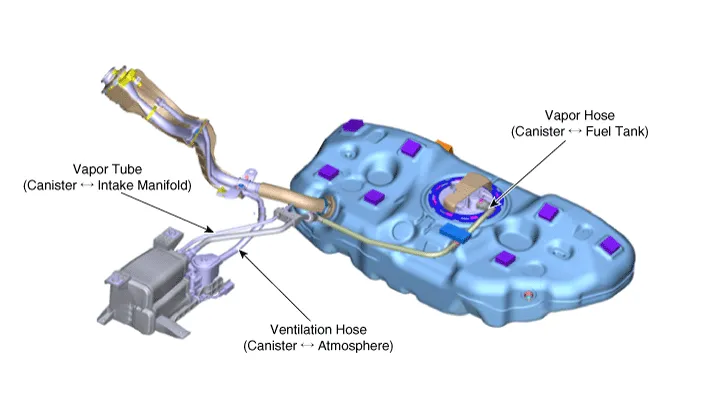
7. Vapor Tube (Canister ↔ Intake Manifold)
8. Vapor Hose (Canister ↔ Fuel Tank)
9. Ventilation Hose (Canister ↔ Atmosphere)
| 1. Canister 4. Fuel Tank Air Filter | 2. Purge Control Solenoid Valve (PCSV) |
|
|
| 3. Fuel Level Sensor (FLS) | 5. Catalytic converter (WCC) |
|
|
| 6. Catalytic converter (UCC) | |
| |
| 7. Vapor Tube (Canister ↔ Intake Manifold) 8. Vapor Hose (Canister ↔ Fuel Tank) 9. Ventilation Hose (Canister ↔ Atmosphere) | |
| |
Evaporative Emission Control System ➤
Exhaust Emission Control System ➤


Other information:
Hyundai Accent (HC) (2017 - 2022) Service Manual: General Safety Information and Caution
- Instructions • The R-1234yf liquid refrigerant is flammable gas. The gas reduces oxygen available for breathing and causes asphyxiation in high concentrations. The victim will not realize that he/she is suffocating. • Inhalation may cause central nervous system effects and may cause drowsiness and dizziness. • Ingestion may cause gastrointestinal discomfort.Hyundai Accent (HC) (2017 - 2022) Service Manual: If You Have a Flat Tire
WARNING Changing a tire can be dangerous. Follow the instructions in this section when changing a tire to reduce the risk of serious injury or death. Whenever possible, change the tire on a firm, level surface away from traffic. CAUTION Be careful as you use the jack handle to stay clear of the flat end. The flat end has sharp edges that could cause cuts.
Contents
- Specifications
- Description and Operation
- Troubleshooting
- Schematic Diagrams
- Components and Components Location
- Evaporative Emission Control System
- Exhaust Emission Control System
Categories
- Manuals Home
- Hyundai Accent Owners Manual
- Hyundai Accent Service Manual
- Questions & Answers
- Video Guides
- Useful Resources
- New on site
- Most important about car
- Privacy Policy

0.0117