
Hyundai Accent (HC): Convenience Features of Your Vehicle / Automatic climate control system
Contents:
- Automatic Heating and Air Conditioning
- Manual Heating and Air Conditioning
- System Operation
- System Maintenance
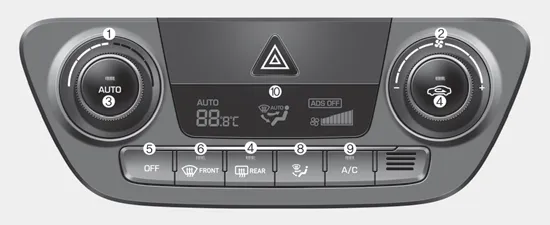
1. Temperature control knob
2. Fan speed control knob
3. AUTO (automatic control) button
4. Air intake control button
5. OFF button
6. Front windshield defrost button
7. Rear window defrost button
8. Mode selection button
9. Air conditioning button
10. Climate control information screen
Automatic Heating and Air Conditioning

The Automatic Climate Control System works by holding the cabin near a set temperature. In a Hyundai Accent equipped with automatic climate control, you mainly choose the desired temperature and the system manages airflow, fan speed, intake mode, and A/C operation.
1. Press the AUTO button.
The selected temperature becomes the target, and the modes, fan speeds, air intake setting, and air-conditioning will be adjusted automatically based on the temperature you choose.

2. Turn the temperature control knob to your preferred setting. If set to the lowest temperature (Lo), the air conditioning system may operate continuously for maximum cooling. After the interior cools sufficiently, move the knob to a higher set point to maintain comfort with less system load.
To exit full automatic operation, press any of the following:
- Mode selection button
- Front windshield defroster button
(Press the button one more time
to deselect the front windshield
defroster function. The 'AUTO'
sign will illuminate on the information
display once again.)
- Fan speed control button
The function you selected will be controlled manually, while other functions continue to operate automatically.
For balanced comfort and efficient operation, many drivers start around 73°F (23°C) and then fine-tune as needed for their Hyundai Accent.
To change the temperature unit from °F to °C or °C to °F:
Press and hold the AUTO and OFF buttons on the climate control unit for 3 seconds.

NOTICE
Do not place objects near the sensor, as it can affect how accurately the Hyundai Accent heating and cooling system regulates cabin temperature.
Manual Heating and Air Conditioning ➤
System Operation
Ventilation
1. Select the Face Level
 mode.
mode.
2. Set the air intake control to the outside (fresh) air position.
3. Set the temperature control to the desired position for comfort in your Hyundai Accent.
4. Set the fan speed control to the desired speed.
Information
For quick cabin refresh, start with fresh air and a medium fan speed for a minute, then adjust as needed.
Heating
1. Select the Floor Level
 mode.
mode.
2. Set the air intake control to the outside (fresh) air position.
3. Set the temperature control to the desired position.
4. Set the fan speed control to the desired speed.
5. If dehumidified heating is desired, turn the air conditioning system on. This can reduce window fogging while warming the Hyundai Accent interior.
If the windshield fogs up, select the Floor & Defrost
 mode or press the Front Defrost
 mode.
mode.
Operation Tips
- To keep dust or unpleasant fumes from entering the car through the ventilation system, temporarily set the air intake control to the recirculated air position. Return the control to the fresh air position when the irritation has passed. This will help keep the driver alert and comfortable.
- To help prevent the inside of the windshield from fogging, set the air intake control to the fresh air position and fan speed to the desired position, turn on the air conditioning system, and adjust the temperature control to the desired temperature.
Air conditioning
All HYUNDAI Air Conditioning Systems are filled with environmentally friendly R-1234yf refrigerant.
1. Start the engine.
2. Push the air conditioning button.
3. Set the mode to the Face Level
 mode.
mode.
4. Set the air intake control to the recirculated air position. However, prolonged operation of recirculation can excessively dry the air; switch back to fresh air periodically for comfort in your Hyundai Accent.
5. Adjust the fan speed control and temperature control to maintain maximum comfort.
When maximum cooling is desired, set the temperature control to the extreme left position, then set the fan speed control to the highest speed. After the interior cools down, reduce fan speed to improve cabin quietness.
NOTICE
When using the air conditioning system, monitor the engine temperature gauge closely while driving up hills or in heavy traffic when outside temperatures are high. Air conditioning system operation can cause engine overheating. Continue to use the fan, but turn the air conditioning system off if the engine temperature gauge indicates engine overheating.
Air conditioning system operation tips
- If the vehicle has been parked in direct sunlight during hot weather, open the windows for a short time to let the hot air inside the vehicle escape before switching on A/C.
- After sufficient cooling has been achieved, switch back from recirculated air to the fresh outside air position to keep the cabin air from feeling stale.
- To help reduce moisture inside the windows on rainy or humid days, decrease humidity by operating the air conditioning system with the windows and sunroof closed.
- Use the air conditioning system every month for a few minutes to help maintain seals and overall system performance.
- If you operate the air conditioner excessively, the temperature difference between outside air and the windshield can cause the outer surface of the windshield to fog up, reducing visibility. In this case, set the mode selection knob or button to the
 position and set the fan speed control to a lower speed.
System Maintenance
Climate control air filter
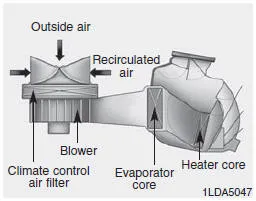
In the Hyundai Accent, the climate control air filter is mounted behind the glove box and works as the first line of defense for cabin air quality. It traps dust, pollen, and other airborne pollutants that can enter through the heating and air conditioning system, helping the vents deliver cleaner air and more consistent airflow.
Have the climate control air filter replaced by an authorized HYUNDAI dealer according to the maintenance schedule. If your Hyundai Accent is driven in severe conditions such as dusty areas, construction zones, or rough roads, more frequent air conditioner filter inspections and replacements are recommended to maintain strong airflow and stable heating/cooling performance.
If the air flow rate suddenly decreases, if the windshield defogging becomes weaker, or if you notice persistent odors, the system should be checked by an authorized HYUNDAI dealer.
Checking the amount of air conditioner refrigerant and compressor lubricant
The air conditioning system relies on the correct refrigerant charge and proper compressor lubrication. When the amount of refrigerant is low, cooling performance is reduced; overfilling can also reduce performance and may lead to abnormal system pressures.
Therefore, if abnormal operation is found, have the Hyundai Accent system inspected by an authorized HYUNDAI dealer.
NOTICE
It is important that the correct type and amount of oil and refrigerant is used. Otherwise, damage to the compressor and abnormal system operation may occur. To prevent damage, the air conditioning system in your Hyundai Accent should only be serviced by trained and certified technicians.
NOTICE
- The refrigerant system should only be serviced by trained and certified technicians to ensure proper and safe operation.
- The refrigerant system should be serviced in a well-ventilated place.
- The air conditioning evaporator (cooling coil) shall never be repaired or replaced with one removed from a used or salvaged vehicle and new replacement MAC evaporators shall be certified (and labeled) as meeting SAE Standard J2842.
WARNING
Vehicles equipped with R-1234yf

Since the refrigerant is mildly flammable and operated at high pressure, the air conditioning system should only be serviced by trained and certified technicians. It is important that the correct type and amount of oil and refrigerant are used for safe, reliable Hyundai Accent A/C operation.
All refrigerants should be reclaimed with proper equipment.
Venting refrigerants directly to the atmosphere is harmful to individuals and environment. Failure to heed these warnings can lead to serious injuries.
Air Conditioning refrigerant label

You can find out which air conditioning refrigerant is applied to your Hyundai Accent on the label located inside of the hood.
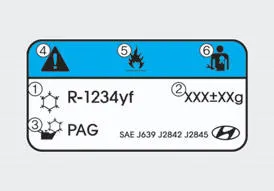
Example
Each symbols and specification on the air conditioning refrigerant label is represented as below:
1. Classification of refrigerant
2. Amount of refrigerant
3. Classification of compressor lubricant
4. Caution
5. Flammable refrigerant
6. To require registered technician to
service air conditioning system


Other information:
Hyundai Accent (HC) (2017 - 2022) Owner's Manual: Exterior Lights
Lighting control To operate exterior lighting on the Hyundai Accent, rotate the knob at the end of the control lever to one of the positions listed below. The available positions may differ by type and equipment. â– Type A â– Type B â– Type C Type A (1) OFF position (2) Parking lamp position (3) Headlamp position Type B (1) OFF position (2) AUTO light position (3) Parking lamp position (4) Headlamp position Type C (1) DRL OFF position (2) AUTO position (3) Parking lamp position (4) Headlamp position Daytime running light (DRL) The Daytime Running Lights (DRL) help other road users notice the front of your Hyundai Accent during daytime driving, particularly in low-angle light after dawn and before sunset.Hyundai Accent (HC) (2017 - 2022) Owner's Manual: Engine Control Module (ECM)
- ECM Terminal and Input/Output signal [M/T] ECM Terminal Function (M/T) Connector [A] Pin NoDescription 1- 2- 3Injector (Cylinder #1-1) [Low] control output 4Injector (Cylinder #1-2) [Low] control output 5- 6- 7- 8- 9- 10- 11Electric EGR Control Valve gorund 12Engine Coolant Temperature Sensor (ECTS) #2 ground 13Ignition Coil (Cylinder #1) control output 14- 15Ignition Coil (Cylinder #4) control output 16Thermal Management Module (TMM) Motor ground 17- 18Engine Cool
Contents
- Automatic Heating and Air Conditioning
- Manual Heating and Air Conditioning
- System Operation
- System Maintenance
Categories
- Manuals Home
- Hyundai Accent Owners Manual
- Hyundai Accent Service Manual
- Questions & Answers
- Video Guides
- Useful Resources
- New on site
- Most important about car
- Privacy Policy

0.0132