
Hyundai Accent (HC): Convenience Features of Your Vehicle / Manual climate control system
Contents:

1. Temperature control knob
2. Mode selection knob
3. Fan speed control knob
4. Air intake control button
5. Rear window defroster button
6. A/C (Air conditioning) button
Heating and Air Conditioning
1. Start the engine of your Hyundai Accent so the heating and cooling system can operate at full performance.
2. Set the mode to the desired position.
To improve the effectiveness of
heating and cooling in the Hyundai Accent, select:
- Heating:

- Cooling:

3. Set the temperature control to the desired position for cabin comfort (warm for heating, cooler for A/C).
4. Set the air intake control to the outside (fresh) air or recirculated air position, depending on traffic, odors, and humidity.
5. Set the fan speed control to the desired speed to match how quickly you want the cabin to change temperature.
6. If air conditioning is desired, turn the air conditioning system on to cool and dehumidify the air.
Mode selection
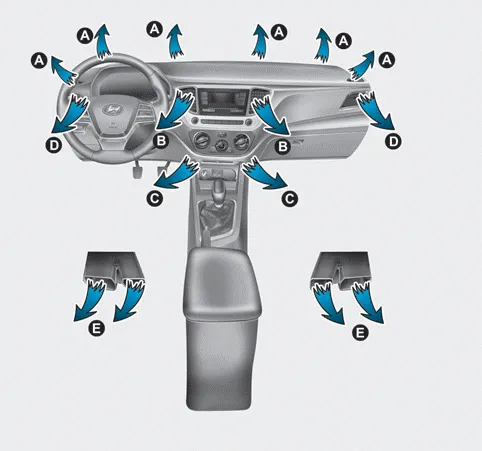
The mode selection knob controls the direction of the air flow through the ventilation system. Air can be directed to the floor, dashboard outlets, or windshield. Five symbols are used to represent Face, Bi-Level, Floor, Floor- Defrost and Defrost air position, allowing you to tune airflow for comfort and clear glass.
Face-Level (B, D)

Air flow is directed toward the upper body and face. Additionally, each outlet can be controlled to aim the air discharged from the outlet, which is useful for cooling the driver and front passenger.
Bi-Level (B, C, D, E)

Air flow is directed towards the face and the floor, balancing quick comfort up top with warmth at your feet.
Floor-Level (A, C, D, E)

Most of the air flow is directed to the floor, with a small amount of the air being directed to the windshield, side window defrosters, and side vents to help reduce window fog.
Floor & Defrost (A, C, D, E)

Most of the air flow is directed to the floor and the windshield with a small amount directed to the side window defrosters, and side vents, which is ideal in cold, damp weather.
Defrost-Level (A, D)

Most of the air flow is directed to the windshield with a small amount of air directed to the side vents for clearer front and side visibility.
MAX A/C-Level (B, D)

The MAX A/C mode is used to cool the inside of the vehicle faster, especially after the Hyundai Accent has been parked in the sun.
In this mode, the air conditioning and the recirculated air position cannot be selected. Turn the fan speed mode to adjust the airflow strength after selecting MAX A/C.
After the interior has cooled sufficiently, whenever possible, move the temperature knob away from Max AC and press the A/C button to maintain comfort with steadier airflow and less noise.
Instrument panel vents
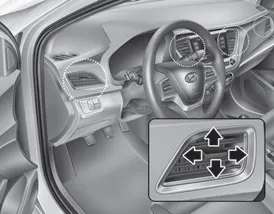
You can adjust the direction of air delivered from these vents using the vent control lever as shown. For best comfort, aim upper vents slightly upward to reduce direct drafts.
Temperature control

The temperature will increase by turning the knob to the right.
The temperature will decrease by turning the knob to the left.
Air intake control

This button is used to select the outside (fresh) air position or recirculated air position, helping you manage odors, dust, and humidity.
Recirculated air position

With the recirculated air position selected, air from the passenger compartment will be drawn through the heating system and heated or cooled according to the function selected, which can cool the cabin faster and reduce outside smells.
Outside (fresh) air position

With the outside (fresh) air position selected, air enters the vehicle from outside and is heated or cooled according to the function selected, keeping cabin air fresher on longer drives.
Information
Using the system in the fresh air position is recommended for most driving because it helps maintain comfort and reduces window fogging.
Prolonged operation of the heater in the recirculated air position (without air conditioning selected) can cause fogging of the windshield and side windows and the air within the passenger compartment will become stale, especially with multiple occupants.
In addition, prolonged use of the air conditioning with the recirculated air position selected will result in excessively dry air in the passenger compartment; switching to fresh air periodically can improve comfort.
WARNING
- Continued use of the climate control system operation in the recirculated air position can cause drowsiness or sleepiness, that may cause loss of vehicle control resulting in an accident. Set the air intake control to the outside (fresh) air position as much as possible while driving in your Hyundai Accent.
- Continued use of the climate control system operation in the recirculated air position (without the air conditioning selected) may allow humidity to increase inside the vehicle which may fog the glass and obscure visibility.
- Do not sleep in a vehicle with the air conditioning or heating system on. It may cause serious injury or death due to a drop in the oxygen level and/or body temperature.
Fan speed control

Turn the knob to the right to increase the fan speed and airflow. Turn the knob to the left to decrease fan speed and airflow, choosing a lower setting for quieter operation.
Setting the fan speed control knob to the "0" position turns off the fan.
NOTICE
Operating the fan speed when the ignition switch is in the ON position could cause the battery to discharge. Operate the fan speed when the engine is running, especially if the vehicle will be parked for an extended time.
Air conditioning

Push the A/C button to turn the system on (indicator light will illuminate) and off. In humid weather, using A/C can help clear fog by removing moisture from the air.
System Operation
Ventilation
1. Select the Face Level
 mode.
mode.
2. Set the air intake control to the outside (fresh) air position.
3. Set the temperature control to the desired position.
4. Set the fan speed control to the desired speed.
Heating
1. Select the Floor Level
 mode.
mode.
2. Set the air intake control to the outside (fresh) air position.
3. Set the temperature control to the desired position.
4. Set the fan speed control to the desired speed.
5. If dehumidified heating is desired,
turn the air conditioning system on.
If the windshield fogs up, select the
Floor & Defrost
 mode or press
the Front Defrost
mode or press
the Front Defrost
 mode.
mode.
Operation Tips
- To keep dust or unpleasant fumes from entering the vehicle through the ventilation system, temporarily set the air intake control to the recirculated air position. Return the control to the fresh air position when the irritation has passed. This will help keep the driver alert and comfortable. As a practical habit in the Hyundai Accent, switch back to fresh air once the source is behind you.
- To help prevent the inside of the windshield from fogging, set the air intake control to the fresh air position and fan speed to the desired position, turn on the air conditioning system, and adjust the temperature control to the desired temperature. This approach works well in rain or during rapid temperature changes.
Small addition: For steady comfort in the Hyundai Accent, avoid frequent knob changes—set a target temperature and fan speed, then fine-tune the mode (Face/Bi-Level/Floor) as conditions change.
h4>Air conditioningEvery Hyundai Accent is designed to keep cabin comfort simple and efficient, and HYUNDAI air conditioning systems are charged from the factory with the environmentally friendlier R-1234yf refrigerant.
1. Start the engine and let it stabilize at idle for a moment so the Hyundai Accent climate controls respond smoothly.
2. Press the air conditioning button to switch the A/C system ON.
3. Select the Face-Level outlet setting so cooled air is directed to the dashboard vents for faster cabin cooling in your Hyundai Accent.
Set the mode to the Face Level
 mode.
mode.
4. Choose the recirculated air position to cool the interior more quickly. Keep in mind that long, continuous use of recirculation can dry the cabin air; when the Hyundai Accent feels too dry or stuffy, switch back to fresh outside air for a short period.
5. Adjust fan speed and temperature together to maintain steady comfort. A moderate fan setting often feels quieter and more consistent once the interior temperature is close to your target.
When you need maximum cooling right away, move the temperature control to the extreme left (coldest) position, then set the fan speed to the highest setting until the cabin cools down, and finally reduce the fan speed for a calmer airflow.
NOTICE
While using the air conditioning system, watch the engine temperature gauge, especially when climbing long grades or moving slowly in heavy traffic during high outside temperatures. Extra A/C load can contribute to higher engine temperatures.
If the gauge shows the engine temperature rising toward overheating, keep the fan running for airflow but switch the A/C OFF until temperatures return to normal.
Air conditioning system operation tips
- If your Hyundai Accent has been parked in direct sun during hot weather, open the windows briefly before turning the A/C on so trapped hot air can escape faster.
- After the cabin has cooled, change from recirculated air back to the fresh outside air position whenever practical to keep the air feeling cleaner.
- On rainy or humid days, reduce window moisture by running the A/C with windows (and sunroof, if equipped) closed; this helps the system dehumidify the cabin air.
- Run the A/C for a few minutes each month, even in cooler seasons, to keep seals lubricated and help maintain consistent performance in your Hyundai Accent.
- If you use the air conditioner for long periods, a big difference between outside temperature and windshield temperature may cause exterior windshield fogging and reduced visibility. If this happens, switch the airflow mode to the
 position
and lower the fan speed to stabilize airflow across the glass.
position
and lower the fan speed to stabilize airflow across the glass. - For the most even comfort, aim the center vents slightly upward and the side vents toward the side windows; this can help balance cooling and reduce localized drafts.
System Maintenance
Climate control air filter
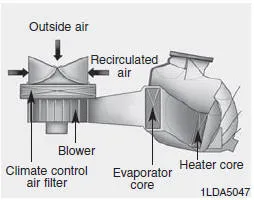
The climate control air filter (cabin filter) sits behind the glove box and helps trap dust, pollen, and other airborne pollutants before they enter the Hyundai Accent passenger compartment through the heating and air conditioning system.
Replace the climate control air filter at the intervals listed in your maintenance schedule, preferably through an authorized HYUNDAI dealer. If the Hyundai Accent is regularly driven in severe conditions (dusty areas, unpaved roads, heavy traffic, or frequent construction zones), the filter may need inspection and replacement more often.
If you notice a sudden drop in airflow from the vents, unusual odors, or the system seems to work harder than usual, have the system checked by an authorized HYUNDAI dealer, as a restricted filter or debris in the HVAC case may be the cause.
Checking the amount of air conditioner refrigerant and compressor lubricant
If the refrigerant charge is low, cooling performance decreases and the system may cycle more frequently. Overfilling can also reduce performance, so correct quantity matters for proper Hyundai Accent A/C operation.
If you suspect abnormal operation (weak cooling, unusual noises, frequent compressor cycling, or persistent fogging issues), have the system inspected by an authorized HYUNDAI dealer to verify refrigerant amount and compressor lubricant condition.
NOTICE
Use only the correct refrigerant and the specified type and amount of compressor oil. Incorrect oil or an incorrect charge level can damage the compressor and cause abnormal system operation. To protect the Hyundai Accent air conditioning system, servicing should be performed only by trained and certified technicians.
NOTICE
- The refrigerant system must be serviced only by trained and certified technicians to ensure safe, correct operation.
- Service the refrigerant system in a well-ventilated area using approved recovery equipment.
- The air conditioning evaporator (cooling coil) must never be repaired or replaced with a unit removed from a used or salvaged vehicle; new replacement MAC evaporators must be certified (and labeled) as meeting SAE Standard J2842.
WARNING
Vehicles equipped with R-1234yf

Because R-1234yf refrigerant is mildly flammable and the system operates under high pressure, the Hyundai Accent air conditioning system should be serviced only by trained and certified technicians. Always use the specified type and correct amount of oil and refrigerant.
All refrigerants must be recovered with proper equipment. Never vent refrigerant to the atmosphere.
Venting refrigerants directly into the air can be harmful to people and the environment. Ignoring these instructions can lead to serious injuries.
Air Conditioning refrigerant label

You can confirm which A/C refrigerant your Hyundai Accent uses by checking the label located inside the hood (engine compartment area).
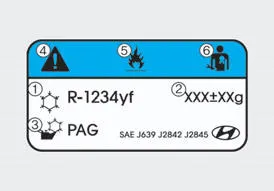
Example
The symbols and specifications shown on the air conditioning refrigerant label typically represent the following:
1. Refrigerant classification
2. Refrigerant quantity
3. Compressor lubricant classification
4. Caution information
5. Flammable refrigerant marking
6. Requirement for a registered technician to service the air conditioning system


Other information:
Hyundai Accent (HC) (2017 - 2022) Owner's Manual: Cylinder Head
- Removal • Use Fender cover to avoid damaging painted surfaces. • To avoid damaging the cylinder head, wait until the engine coolant temperature drops below normal temperature before removing it. • When handling a metal gasket, take care not to fold the gasket or damage the contact surface of the gasket. • To avoid damage, unplug the wiring connectors carefully while holding the connector portion.Hyundai Accent (HC) (2017 - 2022) Owner's Manual: Troubleshooting
Standard Flow of Diagnostic Troubleshooting Notes With Regard To Diagnosis The phenomena listed in the following table are not abnormal.ConditionExplanation System check soundWhen starting the engine, a thudding sound can sometimes be heard coming from inside the engine compartment. This is because the system operation check is being performed.
Contents
Categories
- Manuals Home
- Hyundai Accent Owners Manual
- Hyundai Accent Service Manual
- Questions & Answers
- Video Guides
- Useful Resources
- New on site
- Most important about car
- Privacy Policy

0.0078