
Hyundai Accent (HC): Convenience Features of Your Vehicle / Exterior features
Contents:
Hood
Opening the hood
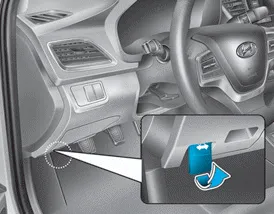
1. Park the vehicle and set the parking brake. For additional safety, park your Hyundai Accent on a level surface and turn off the engine before opening the hood.
2. Pull the release lever to unlatch the hood. The hood should pop open slightly.
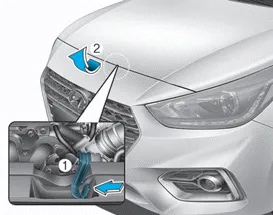
3. Go to the front of the vehicle, raise the hood slightly, push up the secondary latch (1) inside of the hood center and lift the hood (2).
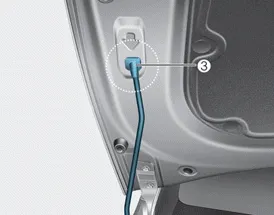
4. Pull out the support rod and hold the hood open with the support rod (3).
WARNING
- Hold the rubber wrapped portion of the supporting rod only, DO NOT hold the metal portion of the rod.
- The support rod must be inserted completely into the hole provided whenever you inspect the engine compartment. This will prevent the hood from falling and possibly injuring you.
Closing the hood
1. Before closing the hood, check the following:
- All filler caps in engine compartment must be correctly installed.
- Gloves, rags or any other combustible material must be removed from the engine compartment.
2. Lower the hood halfway (lifted approximately 12 inches (30 cm) from the closed position) and push down to securely lock in place. Then double check to be sure the hood is secure. If the hood can be raised slightly, it is not securely locked. Open it again and close it with more force.
Hood open warning
The warning message will appear on the LCD display when hood is open.
The warning chime will operate when the vehicle is being driven at or above 3 km/h with the hood open.
WARNING
- Before closing the hood, ensure all obstructions are removed from around the hood opening.
- Always double check to be sure that the hood is firmly latched before driving away. Check there is no hood open warning light or message displayed on the instrument cluster. Driving with the hood opened may cause a total loss of visibility, which might result in an accident.
- Do not move the vehicle with the hood in the raised position, as vision is obstructed, which might result in an accident, and the hood could fall or be damaged.
Extra tip for Hyundai Accent owners: as part of routine care, keep the sunroof rails and the hood latch area clean—simple maintenance can help reduce noise, improve smooth operation, and support long-term reliability.
Trunk
Opening the trunk
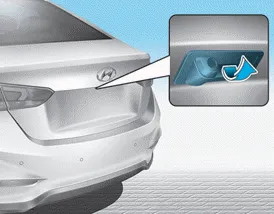
Outside
1. Make sure the shift lever is in P (Park). For safety, confirm the Hyundai Accent is fully stopped and the parking brake is set before loading cargo.
2. Then do one of the following:
- Press the button on the trunk handle after locking or unlocking the door by remote key or smart key.
- Press the trunk unlock button of the remote key or smart key for more than 1 second.
- Press the button on the trunk itself with the Smart Key in your possession.
WARNING
The button (1) on the trunk handle is made of rubber. Do not press it with sharp objects such as a key, screwdriver, or drill, as this may damage the button and affect proper trunk operation on your Hyundai Accent.
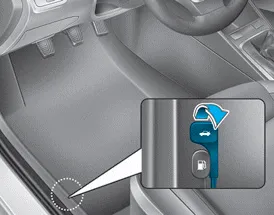
â– Inside
- Use the trunk release lever.
3. Lift the trunk lid up.
Closing the trunk
Lower the trunk lid and press down until it locks. To be sure the trunk lid is securely fastened, always check by trying to pull it up again. A fully latched trunk helps reduce wind noise and helps keep the Hyundai Accent cabin sealed from dust and exhaust.
WARNING
Always keep the trunk lid completely closed while the vehicle is in motion. If it is left open or ajar, poisonous exhaust gases containing carbon monoxide (CO) may enter the vehicle and serious illness or death may result.
WARNING
Make sure there are no people or objects around the trunk before opening or closing the Power Trunk. Wait until the trunk is fully open and stopped before loading or unloading cargo from the vehicle.
NOTICE
To prevent damage to the trunk lift torsion bars and the attached hardware, always close the trunk before driving.
Information
In cold and wet climates, trunk lock and trunk mechanisms may not work properly due to freezing conditions. If the latch feels stiff, avoid forcing it and allow ice to melt or the vehicle to warm up.
WARNING
- NEVER allow anyone to occupy the trunk of the vehicle at any time. If the trunk is partially or totally latched and the person is unable to get out, serious injury or death could occur due to lack of ventilation, exhaust fumes and rapid heat build-up, or because of exposure to cold weather conditions. The trunk is also a highly dangerous location in the event of a crash because it is not a protected occupant space but is a part of the vehicle’s crush zone.
- Your vehicle should be kept locked and the Smart Key should be kept out of the reach of children. Parents should teach their children about the dangers of playing in trunks, especially around the rear of the Hyundai Accent.
Emergency trunk safety release
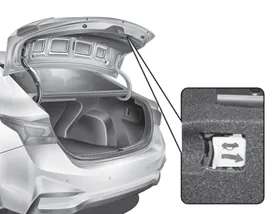
Your vehicle is equipped with an Emergency Trunk Safety Release lever located inside the trunk. When someone is inadvertently locked in the trunk, the trunk can be opened by moving the lever in the direction of the arrow and pushing the trunk open. Always keep the trunk area clear enough so the lever remains accessible.
Smart Trunk
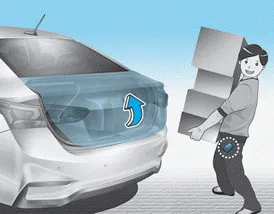
On a Hyundai Accent equipped with a smart key, the trunk can be opened using the Smart Trunk system, which supports hands-free access when you are carrying the smart key and standing behind the vehicle.
How to use the Smart Trunk
The trunk can be opened with no-touch activation, as long as all the conditions below are satisfied:
- After 15 seconds when all doors are closed and locked
- Positioned in the detecting area for more than 3 seconds.
Information
• The Smart Trunk does not operate when:
- The smart key is detected within 15 seconds after the doors are closed and locked, and is continuously detected.
- The smart key is detected within 15 seconds after the doors are closed and locked, and within 60 inches (1.5 m) from the front door handles (for vehicles equipped with Welcome Light).
- A door is not locked or closed.
- The smart key is in the vehicle.
1. Setting
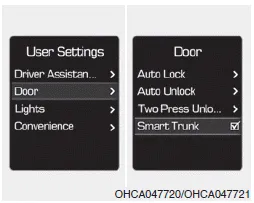
1. Setting
To activate the Smart Trunk, go to User Settings Mode and select Smart Trunk on the LCD display. Once enabled, the Hyundai Accent can automatically open the trunk when the detection conditions are met.
2. Detect and Alert
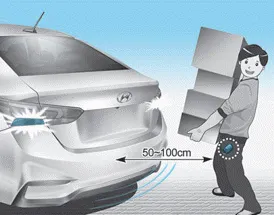
If you are positioned in the detecting area (20 ~ 40 inches (50 ~ 100 cm) behind the vehicle) carrying a smart key, the hazard warning lights will blink and a chime will sound to alert you the smart key has been detected and the trunk will open. This is helpful when your hands are full and you want quick access to the Hyundai Accent trunk.
Information
Do not approach the detecting area if you do not want the trunk to open. If you have unintentionally entered the detecting area and the hazard warning lights and chime start to operate, leave the detecting area with the smart key. The trunk will stay closed.
3. Automatic opening
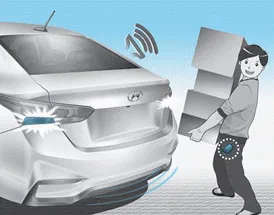
The hazard warning lights will blink and a chime will sound 6 times and then the trunk will open.
WARNING
- Make sure you close the trunk before driving your vehicle.
- Make sure there are no people or objects around the trunk before opening or closing the trunk.
- Make sure objects in the trunk do not come out when opening the trunk on a slope. It may cause serious injury.
- Make sure to deactivate the Smart Trunk when washing your vehicle. Otherwise, the trunk may open inadvertently.
- The key should be kept out of reach of children. Children may inadvertently open the Smart Trunk while playing around the rear area of the vehicle.
How to deactivate the Smart Trunk function using the smart key
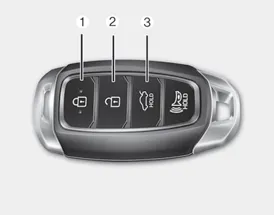
1. Door lock
2. Door unlock
3. Trunk open
If you press any button of the smart key during the Detect and Alert stage, the Smart Trunk function will be deactivated. This gives you quick control if you do not want the Hyundai Accent trunk to open automatically.
Make sure to be aware of how to deactivate the Smart Trunk function for emergency situations. Knowing these steps can prevent unintended opening in tight spaces or crowded areas.
Information
- If you press the door unlock button (2), the Smart Trunk function will be deactivated temporarily. But, if you do not open any door for 30 seconds, the smart trunk function will be activated again.
- If you press the trunk open button (3) for more than 1 second, the trunk opens.
- If you press the door lock button (1) or trunk open button (3) when the Smart Trunk function is not in the Detect and Alert stage, the smart trunk function will not be deactivated.
- In case you have deactivated the Smart Trunk function by pressing the smart key button and opened a door, the smart trunk function can be activated again by closing and locking all doors.
Extra tip for Hyundai Accent owners: when using hands-free Smart Trunk in busy parking areas, stand slightly to one side as the trunk opens and keep a firm hold on cargo—this improves safety and helps prevent items from shifting or falling as the lid lifts.
Detecting area
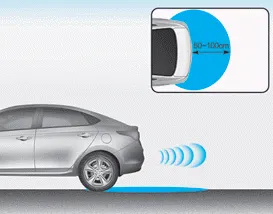
- The Hyundai Accent Smart Trunk operates with a welcome alert when the smart key is detected within 20~40 inches (50~100 cm) from the trunk, helping you open the trunk hands-free when approaching from the rear.
- The alert stops immediately if the smart key is positioned outside the detecting area during the Detect and Alert stage, which helps prevent unintentional opening.
Information
- The Smart Trunk function will not work if any of the following occurs:
- The smart key is close to a radio transmitter such as a radio station or an airport which can interfere with normal operation of the transmitter.
- The smart key is near a mobile two way radio system or a cellular phone.
- Another vehicle's smart key is being operated close to your vehicle. - The detecting range may decrease or increase when :
- One side of the tire is raised to replace a tire or to inspect the vehicle.
- The vehicle is parked on a slope or unpaved road, etc.
Extra tip for Hyundai Accent owners: if you do not want the Smart Trunk to open, step away from the rear detecting area with the smart key until the alert stops completely.
Fuel Filler Door
Opening the fuel filler door
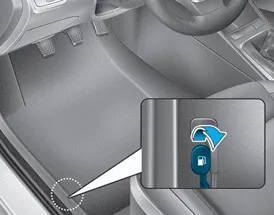
The fuel filler door must be opened from inside the vehicle by pulling the fuel filler door opener lever. For safe refueling in your Hyundai Accent, always park securely and keep the engine OFF.
1. Turn the engine off.
2. Pull the fuel filler door opener lever.
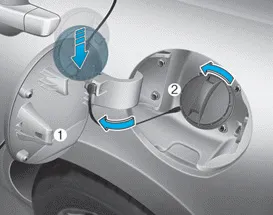
3. Pull the fuel filler door (1) out to fully open.
4. To remove the fuel tank cap (2), turn it counterclockwise. You may hear a hissing noise as the pressure inside the tank equalizes, which is normal during refueling.
5. Place the cap on the fuel filler door.
Information
If the fuel filler door does not open because ice has formed around it, tap lightly or push on the door to break the ice and release the door. Do not pry on the door. If necessary, spray around the door with an approved deicer fluid (do not use radiator antifreeze) or move the vehicle to a warm place and allow the ice to melt.
Closing the fuel filler door
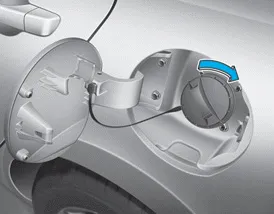
1. To install the fuel tank cap, turn it clockwise until it "clicks" one time.
2. Close the fuel filler door until it is latched securely. After closing, give the door a light press to confirm it is fully seated on your Hyundai Accent.
WARNING
Gasoline is highly flammable and explosive. Failure to follow these guidelines may result in SERIOUS INJURY or DEATH:
- Read and follow all warnings posted at the gas station.
- Before refueling, note the location of the Emergency Gasoline Shut-Off, if available, at the gas station.
- Before touching the fuel nozzle, you should eliminate the potential build-up of static electricity by touching a metal part of the vehicle, a safe distance away from the fuel filler neck, nozzle, or other gas source, with your bare hand.
- Do not use cellular phones while refueling. Electric current and/or electronic interference from cellular phones can potentially ignite fuel vapors and cause a fire.
- Do not get back into a vehicle once you have begun refueling. You can generate a buildup of static electricity by touching, rubbing or sliding against any item or fabric capable of producing static electricity. Static electricity discharge can ignite fuel vapors causing a fire. If you must re-enter the vehicle, you should once again eliminate potentially dangerous static electricity discharge by touching a metal part of the vehicle, away from the fuel filler neck, nozzle or other gasoline source, with your bare hand.
- When using an approved portable fuel container, be sure to place the container on the ground prior to refueling. Static electricity discharge from the container can ignite fuel vapors causing a fire. Once refueling has begun, contact between your bare hand and the vehicle should be maintained until the filling is complete.
- Use only approved portable plastic fuel containers designed to carry and store gasoline.
- When refueling, always move the shift lever to the P (Park) position (for intelligent variable transmission) or first gear or R (Reverse, for manual transmission), set the parking brake, and place the ignition switch to the LOCK/ OFF position. Sparks produced by electrical components related to the engine can ignite fuel vapors causing a fire.
- Do not use matches or a lighter and do not smoke or leave a lit cigarette in your vehicle while at a gas station, especially during refueling.
- Do not over-fill or top-off your vehicle tank, which can cause gasoline spillage.
- If a fire breaks out during refueling, leave the vicinity of the vehicle, and immediately contact the manager of the gas station and then contact the local fire department. Follow any safety instructions they provide.
- If pressurized fuel sprays out, it can cover your clothes or skin and thus subject you to the risk of fire and burns. Always remove the fuel cap carefully and slowly. If the cap is venting fuel or if you hear a hissing sound, wait until the condition stops before completely removing the cap.
- Always check that the fuel cap is installed securely to prevent fuel spillage in the event of an accident.
Information
Make sure to refuel your vehicle according to the "Fuel Requirements" suggested in the Introduction chapter.
NOTICE
- Do not spill fuel on the exterior surfaces of the vehicle. Any type of fuel spilled on painted surfaces may damage the paint.
- If the fuel filler cap requires replacement, use only a genuine HYUNDAI cap or the equivalent specified for your vehicle. An incorrect fuel filler cap can result in a serious malfunction of the fuel system or emission control system.


Other information:
Hyundai Accent (HC) (2017 - 2022) Owner's Manual: Changing Tires
WARNING A vehicle can slip or roll off of a jack causing serious injury or death to you or those nearby. Take the following safety precautions: Never place any portion of your body under a vehicle that is supported by a jack. Your Hyundai Accent must be supported only at the correct jacking points and must never be relied on as a “stand.� NEVER attempt to change a tire in the lane of traffic.Hyundai Accent (HC) (2017 - 2022) Owner's Manual: Light bulbs
Consult an authorized HYUNDAI dealer to replace most vehicle light bulbs. It is difficult to replace many Hyundai Accent light bulbs because other parts of the vehicle must be removed before you can get to the bulb. This is especially true when removing the headlamp assembly to access certain bulb(s), or when LED components are integrated into the lamp housing.
Contents
Categories
- Manuals Home
- Hyundai Accent Owners Manual
- Hyundai Accent Service Manual
- Questions & Answers
- Video Guides
- Useful Resources
- New on site
- Most important about car
- Privacy Policy

0.0072