
Hyundai Accent (HC): Suspension System
Hyundai Accent (HC) (2017 - 2022) Service Manual / Suspension System
Contents:
- Specifications
- Special Service Tools
- Troubleshooting
- Front Suspension System
- Rear Suspension System
- Tires/Wheels
- Tire Pressure Monitoring System
Specifications
| Item | Specification | |
| Suspension type | Mac Pherson Strut | |
| Shock absorber | Type | General Valve |
| Item | Specification | |
| Suspension type | Couple Torsion Beam Axle | |
| Shock absorber | Type | General Valve |
| Item | Specification | |
| Wheel | Aluminum | 5.5J * 15 |
| 6.5J * 17 | ||
| Steel | 5.5J * 15 | |
| Tire | 185/65 R15 | |
| 205/45 R17 | ||
| Spare tire | T125/80 R15 | |
| Tire pressure kg/cm² (psi) | 185/65 R15 | 230 (33) |
| 205/45 R17 | 230 (33 ) | |
| T125/80 R15 | 420 (60) | |
| Item | Specification | ||
| Front | Toe-in | Total | 0.15° ± 0.2° |
| Individual | 0.075° ± 0.1° | ||
| Camber angle | -0.5 ± 0.5° | ||
| Caster angle | 4.64° ± 0.5° | ||
| King-pin angle | 13.23° ± 0.5° | ||
| Ride Height | 367 ± 10 mm (14.4488 ± 0.3937 in) | ||
| Rear | Toe-in | Total | 0.3° ± 0.3° |
| Individual | 0.15° ± 0.15° | ||
| Camber angle | -1.5° ± 0.5° | ||
| Ride Height (Full fuel condition) | 368 ± 10 mm (14.4881 ± 0.3937 in) | ||
| Item | Tightening torque (kgf.m) | ||
| N.m | kgf.m | lb-ft | |
| Hub nuts | 107.9 - 127.5 | 11.0 - 13.0 | 79.6 - 94.0 |
| Front strut assembly to front axle | 98.1 - 117. | 10.0 - 12.0 | 72.3 - 86. |
| Front strut assembly to body | 49.0 - 58.8 | 5.0 - 6.0 | 36.2 - 43.4 |
| Lower arm to sub frame (Front) | 117.7 - 137.3 | 12.0 - 14.0 | 86.8 - 101.3 |
| Lower arm to sub frame (Rear) | 156.9 - 176.5 | 16.0 - 18.0 | 115.7 - 130.2 |
| Lower arm to knuckle | 58.8 - 70.6 | 6.0 - 7.2 | 43.4 - 52.1 |
| Tie rod end castle nut | 23.5 - 33.4 | 2.4 - 3.4 | 17.4 - 24.5 |
| Steering gear box to sub frame | 88.3 - 107.9 | 9.0 - 11.0 | 65.1 - 79.6 |
| Stabilizer bar to stabilizer link | 98.1 - 117.7 | 10.0 - 12.0 | 72.3 - 86.8 |
| Stabilizer bar to sub frame | 44.1 - 53.9 | 4.5 - 5.5 | 32.5 - 39.8 |
| Stabilizer bar to front strut assembly | 98.1 - 117.7 | 10.0 - 12.0 | 72.3 - 86.8 |
| Sub frame mounting to body bolt & nut | 176.5 - 196.1 | 18.0 - 20.0 | 130.2 - 144.7 |
| Bolt connecting universal joint to pinion (M8 BOLT) | 32.4 - 37.3 | 3.3 - 3.8 | 23.9 - 27.5 |
| Bolt connecting universal joint to pinion (M10 BOLT) | 49.0 - 58.8 | 5.0 - 6.0 | 36.2 - 43.4 |
| Roll rod bracket to roll rod support bracket fixing bolt & nut | 107.9 - 127.5 | 11.0 - 13.0 | 79.6 - 94.0 |
| Item | Tightening torque (kgf.m) | ||
| N.m | kgf.m | lb-ft | |
| Hub nuts | 107.9 - 127.5 | 11.0 - 13.0 | 79.6 - 94.0 |
| Shock absorber to body | 49.0 - 63.7 | 5.0 - 6.5 | 36.2 - 47.0 |
| Shock absorber to torsion beam axle | 98.1 - 117.7 | 10.0 - 12.0 | 72.3 - 86.8 |
| Torsion beam axle to body | 117.7 - 137.3 | 12.0 - 14.0 | 86.8 - 101.3 |
| Bitmap Torsion beam axle to brake caliper | 63.7 - 73.5 | 6.5 - 7.5 | 47.0 - 54.2 |
| Shock absorber lock nut | 19.6- 24.5 | 2.0 - 2.5 | 14.5 - 18.1 |
Special Service Tools
| Tool (Number and Name) | Illustration | Use |
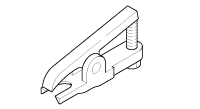
| 09568-1S100 |
| Saperate the ball joint from the front alxe |
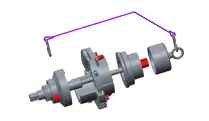
| 09546-3X100 Shock absorber lock nut removal tool |
| Used for remove the shock absorber lock nut. |
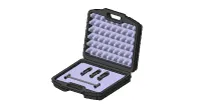
| 09551-AL100 Rear torsion beam axle bush removal / installation tool |
| Rear torsion beam axle bush removal and installation tool |
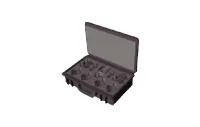
| 09545-AL100 Front lower arm G bushing replacement tool |
| Used for replacement of the front lower arm G bushing |
Troubleshooting
| Symptom | Possible cause | Remedy |
| Hard steering | Improper front wheel alignment Excessive turning resistance of lower arm ball joint Low tire pressure No power assist | Correct Replace Adjust Repair and replace |
| Poor return of steering wheel to center | Improper front wheel alignment | Correct |
| Poor or rough ride | Improper front wheel alignment Malfunctioning shock absorber Broken or worn stabilizer Broken or worn coil spring Worn lower arm bushing | Correct Repair or replace Replace Replace Replace the lower arm assembly |
| Abnormal tire wear | Improper front wheel alignment Improper tire pressure Malfunctioning shock absorber | Correct Adjust or replace Replace |
| Wandering | Improper front wheel alignment Poor turning resistance of lower arm ball joint Loose or worn lower arm bushing | Correct Repair Retighten or replace |
| Vehicle pulls to one side | Improper front wheel alignment Excessive turning resistance of lower arm ball joint Broken or worn coil spring Bent lower arm | Correct Replace Replace Repair |
| Steering wheel shimmy | Improper front wheel alignment Poor turning resistance of lower arm ball joint Broken or worn stabilizer Worn lower arm bushing Malfunctioning shock absorber Broken or worn coil spring | Correct Replace Replace Replace Replace Replace |
| Bottoming | Broken or worn coil spring Malfunctioning shock absorber | Replace Replace |
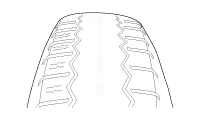
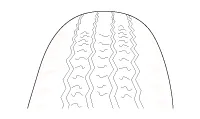
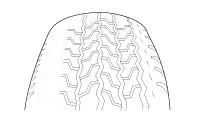
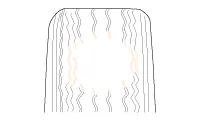
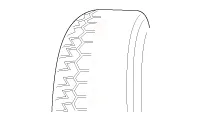
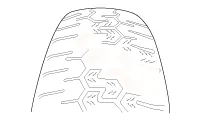
Wheel / tire noise, vibration and harshness concerns are directly related to vehicle speed and are not generally affected by acceleration, coasting or decelerating. Also, out-of-balance wheel and tires can vibrate at more than one speed. A vibration that is affected by the engine rpm, or is eliminated by placing the transmission in Neutral is not related to the tire and wheel. As a general rule, tire and wheel vibrations felt in the steering wheel are related to the front tire and wheel assemblies. Vibrations felt in the seat or floor are related to the rear tire and wheel assemblies. This can initially isolate a concern to the front or rear.Careful attention must be paid to the tire and wheels. There are several symptoms that can be caused by damaged or worn tire and wheels. Perform a careful visual inspection of the tires and wheel assemblies. Spin the tires slowly and watch for signs of lateral or radial runout. Refer to the tire wear chart to determine the tire wear conditions and actions
| Wheel and tire diagnosis | ||||||||||||||||||||||||||
| Rapid wear at the center | Rapid wear at both shoulders | Wear at one shoulder | ||||||||||||||||||||||||
|
|
| ||||||||||||||||||||||||
|
|
| ||||||||||||||||||||||||
| Partial wear | Feathered edge | Wear pattern | ||||||||||||||||||||||||
|
|
| ||||||||||||||||||||||||
|
|
| ||||||||||||||||||||||||
Front Suspension System ➤
Rear Suspension System ➤
Tires/Wheels ➤
Tire Pressure Monitoring System ➤


Other information:
Hyundai Accent (HC) (2017 - 2022) Service Manual: Explanation of scheduled maintenance items
Engine Oil and Filter The engine oil and filter should be changed at the intervals specified in the maintenance schedule. If the Hyundai Accent is being driven in severe conditions, more frequent oil and filter changes are required to protect the engine from accelerated wear and sludge buildup. Drive Belts Inspect all drive belts for evidence of cuts, cracks, excessive wear or oil saturation and replace if necessary.Hyundai Accent (HC) (2017 - 2022) Service Manual: Description and Operation
- Function NoItemDescription 1Washer Linked Wiper – If the washer switch is pressed ON for 0.06 second with the vehicle mode in IGN2, the wiper relay is turned ON after washer switch ON, and then the wiper relay is turned OFF after wiper parking signal ON. 2MIST Linked Wiper – If the wiper mist switch is pressed ON for 0.6 second with the vehicle mode in IGN2, the wiper relay is turned ON, and then OFF after wiper parking signal ON.
Contents
- Specifications
- Special Service Tools
- Troubleshooting
- Front Suspension System
- Rear Suspension System
- Tires/Wheels
- Tire Pressure Monitoring System
Categories
- Manuals Home
- Hyundai Accent Owners Manual
- Hyundai Accent Service Manual
- Questions & Answers
- Video Guides
- Useful Resources
- New on site
- Most important about car
- Privacy Policy

Copyright © 2026
0.0105
0.0105